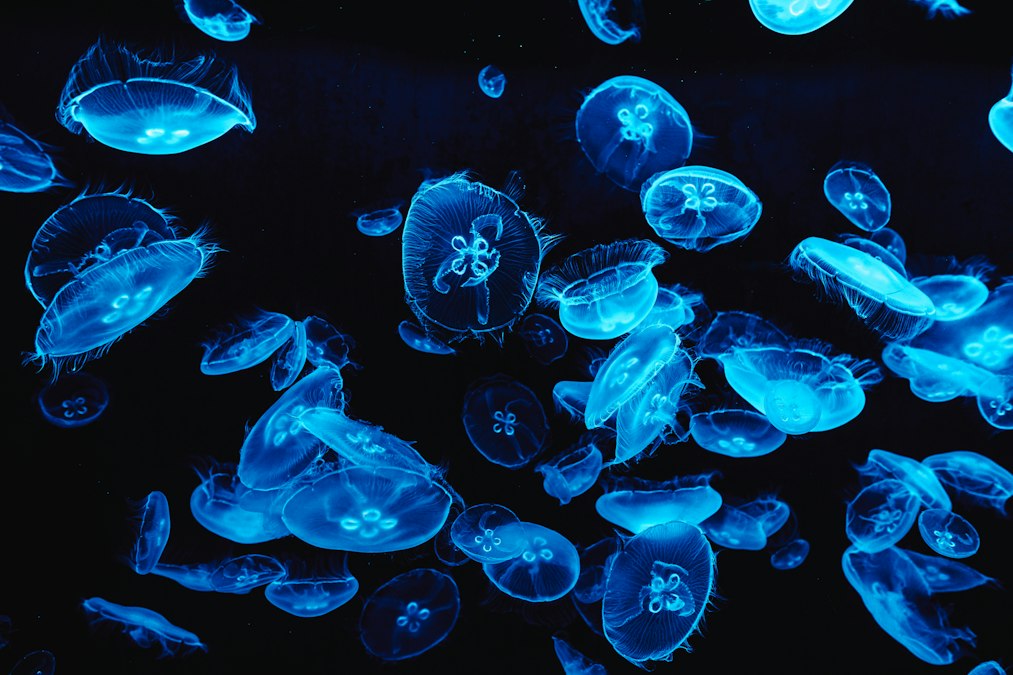
A firefly lighting up a July backyard and an electric eel stunning a fish in the Amazon are sometimes dropped into the same sentence, as if they’re two flavors of the same party trick. They are not. One is a chemical reaction that produces light. The other is a voltage difference across a membrane that produces current. Confuse them and you miss what each one actually teaches about how living things work, which is a shame, because they’re both excellent lessons, just not the same lesson.
The confusion is understandable. Both words have “bio” bolted to a Latin root for something flashy, light in one case, electricity in the other. Both show up in the same breathless lists of “amazing things nature can do.” And both get invoked, often sloppily, in pop science coverage of glowing animals and electric fish in the same breath, as though an angler fish and a torpedo ray are running the same hardware. They are not running the same hardware. They’re not even in the same category of phenomenon. Bioluminescence is photochemistry. Bioelectricity is electrophysiology. One makes light, the other moves charge, and the overlap between the two is mostly coincidental: a handful of organisms happen to do both, for unrelated reasons.
Bioluminescence Is a Chemical Reaction, Not a Current
Bioluminescence happens when an enzyme called luciferase catalyzes the oxidation of a light-emitting molecule called luciferin. The reaction releases energy, and instead of dissipating entirely as heat, some of that energy kicks an electron into an excited state. When the electron drops back down, it emits a photon. That’s the whole mechanism, discovered piece by piece over more than a century, with major clarifying work on firefly luciferase done by Princeton’s William McElroy in the 1940s and 1950s and on jellyfish photoproteins by Osamu Shimomura, whose isolation of green fluorescent protein from the jellyfish Aequorea victoria in 1962 eventually won him a share of the 2008 Nobel Prize in Chemistry alongside Martin Chalfie and Roger Tsien.
Notice what’s absent from that description: ion channels, membrane voltage, neurons, anything electrical at all. Bioluminescence is a biochemical light bulb, not a circuit. It requires luciferin, oxygen, and usually ATP or a related cofactor, and it happens in specialized cells or organs, photophores in fish and squid, the light organs of fireflies, symbiotic bacteria in anglerfish lures. Some organisms make their own luciferin. Others, like many deep-sea fish, borrow it from bioluminescent bacteria they host in dedicated pouches, a relationship that is itself worth an article on its own. The light is a byproduct of chemistry. Electricity never enters the picture, except in the trivial sense that all chemistry involves electrons moving between atoms. That’s not what anyone means by bioelectricity.
Bioluminescence is a biochemical light bulb. Bioelectricity is a wire.
Bioelectricity Is a Voltage Difference, and It Runs Nearly Everything
Bioelectricity refers to the electrical potential that exists across the membrane of essentially every living cell, not just neurons. Cells pump ions, sodium, potassium, calcium, chloride, across their membranes using proteins embedded in the lipid bilayer, creating a charge imbalance between the inside and outside of the cell. A resting neuron sits at roughly negative 70 millivolts relative to the outside world. That’s not a metaphor. It’s a measurable voltage, the same unit you’d use for a battery, just six orders of magnitude smaller.
When that voltage changes rapidly, when sodium channels fly open and the membrane potential spikes toward positive territory before potassium channels slam it back down, you get an action potential. String enough of those together down an axon and you get a nerve signal. That’s the bioelectricity most people picture, the neural kind, the kind Hodgkin and Huxley described mathematically in their 1952 model of the squid giant axon, work that won them the 1963 Nobel Prize in Physiology or Medicine. But neurons are not special in having a membrane potential. Muscle cells have one. Immune cells have one. Skin cells, bone cells, and the epithelial cells lining your gut have one too. Michael Levin’s lab at Tufts has spent two decades showing that these non-neural voltage gradients help pattern embryonic development, control regeneration in organisms like planaria and frogs, and even guide how cells decide what body part to become. None of that requires a nervous system. It requires ion channels and gap junctions, the electrical wiring that predates neurons by a long evolutionary stretch.
The electric eel is the one organism people actually mean when bioluminescence and bioelectricity get mentally merged, because it’s the most famous “electric animal,” and it has nothing to do with light at all. Electrophorus electricus generates its shock using modified muscle cells called electrocytes, stacked in series like thousands of tiny batteries, each contributing a small voltage that sums to several hundred volts in a discharge. Kenneth Catania at Vanderbilt has published extensively on how eels use graded voltage, low-voltage probing pulses to locate prey, high-voltage bursts to stun it, and even curling maneuvers that double the effective shock delivered to a target. That’s bioelectricity doing real mechanical work in the world. It is not luciferase. It is not light. It’s muscle tissue repurposed into a high-voltage battery.
The electric eel is bioelectricity’s most famous organism, and it doesn’t glow at all.
Where the Two Actually Overlap, Briefly and Narrowly
There is one place these fields genuinely intersect, and it’s worth being precise about it rather than hand-waving toward “nature is amazing.” Bioluminescent reporters are now a standard tool for reading out bioelectric and cellular activity in labs that have nothing to do with glowing animals in the wild. Researchers fuse luciferase genes to promoters that switch on under specific cellular conditions, then use the resulting light output as a proxy signal, a way to see, from outside an organism or dish, what’s happening inside cells without cutting them open. Calcium imaging, a technique used extensively in neuroscience to track neural activity indirectly, often relies on fluorescent or luminescent proteins that change their light output in response to calcium flux, which itself is downstream of electrical activity in the cell. GCaMP, a widely used genetically encoded calcium indicator developed through work spanning multiple labs including Junichi Nakai’s and later refined for neuroscience applications at Janelia Research Campus, is fluorescent rather than bioluminescent in its most common form, but luciferase-based calcium sensors exist too, and the logic is the same: light as a readout, electricity as the underlying event.
This is a genuinely useful convergence, but it’s an instrumentation trick, not evidence that the two phenomena share a mechanism. The light doesn’t cause the electrical event and the electrical event doesn’t cause the light directly, a chemical or genetic intermediary sits between them. Researchers chose bioluminescence and fluorescence as reporting tools because light is easy to detect with a camera and voltage is comparatively hard to detect non-invasively at scale. That practical convenience has nothing to do with any shared biology between the two phenomena. Fireflies and jellyfish were not quietly electric the whole time. Electric eels and the ion channels patterning a regenerating axolotl limb are not secretly luminous. They are different solutions to different problems, deployed by evolution for different reasons, that happen to be legible using overlapping laboratory tools.
Why the Mix-Up Persists, and Why It Matters for How People Understand the Science
Part of the blame belongs to vocabulary. “Bio-” prefixes multiply fast in popular science writing, and once you’ve grouped bioluminescence and bioelectricity into the same mental bin, “weird things living creatures do with energy,” the distinction collapses. Part of the blame belongs to the animals themselves. The anglerfish’s glowing lure and the electric eel’s shock both read, to a casual observer, as “nature’s special effects,” which flattens a chemical process and an electrophysiological one into the same emotional category even though the underlying science has almost nothing in common.
The stakes of getting this right are not purely pedantic. Bioelectricity is the foundation of an entire branch of medicine, bioelectronic medicine, electroceuticals, neural interfaces, deep brain stimulation, vagus nerve stimulation, cardiac pacing, all of it dependent on the fact that cells run on voltage and that voltage can be read, interpreted, and in some cases rewritten with an electrode. Kevin Bullock and researchers across institutions working on bioelectric medicine are trying to treat disease by manipulating the same ion channel and membrane potential systems that Levin studies in regenerating limbs and that Hodgkin and Huxley first modeled in a squid axon. None of that research program has any analog in bioluminescence. You cannot build a pacemaker out of luciferase. You cannot treat epilepsy by tweaking an organism’s light-emitting chemistry, because epilepsy is a disorder of electrical signaling, not photochemistry. Bioluminescence research, meanwhile, has its own serious medical and scientific payoff, mainly as an imaging and diagnostic tool: luciferase-based assays are used to detect ATP contamination in food safety testing, to track tumor growth in mouse models by engineering cancer cells to glow, and to report on gene expression in countless molecular biology experiments. That’s a real and valuable scientific legacy. It’s just a different legacy from the one bioelectricity is building.
You cannot build a pacemaker out of luciferase.
| Feature | Bioluminescence | Bioelectricity |
|---|---|---|
| Underlying mechanism | Luciferase-catalyzed chemical oxidation of luciferin | Ion gradients across cell membranes, created by ion pumps and channels |
| What it produces | Photons (visible light) | Voltage and current |
| Found in | A limited set of organisms: fireflies, certain fish, jellyfish, dinoflagellates, symbiotic bacteria | Essentially all living cells, in every organism |
| Key historical figure | Osamu Shimomura (GFP isolation, 1962) | Alan Hodgkin and Andrew Huxley (action potential model, 1952) |
| Medical application today | Imaging, gene expression reporters, diagnostics | Pacemakers, neural interfaces, vagus nerve stimulation, deep brain stimulation |
Two Different Toolkits, Not a Spectrum
The clean way to hold these two ideas apart is to stop picturing them as adjacent points on a single scale of “biological energy phenomena” and start treating them as two different toolkits an organism, or a researcher, reaches for depending on the job. Need to attract a mate in the dark, lure prey with a fake light source, or startle a predator with a sudden flash? That’s a job for luciferase and luciferin, chemistry built for producing photons. Need to sense the environment, move a muscle, pattern an embryo, regenerate a limb, or stun a fish thirty times your size? That’s a job for ion channels and membrane voltage, machinery built for moving charge. The electric eel never needed to glow. The anglerfish’s lure never needed a membrane potential to do its job, beyond the ordinary resting potential every one of its cells already carries just to stay alive.
What’s worth sitting with is how much more foundational bioelectricity turns out to be once you look past the eel-and-firefly framing. Bioluminescence is a specialized adaptation, evolved independently more than forty separate times across the tree of life according to the long-running work of biologists like Edith Widder, but still confined to a minority of species and almost entirely absent from land vertebrates aside from a few fungi and insects. Bioelectricity is not a specialized adaptation. It’s a baseline condition of being a living cell. Every neuron firing in a human brain, every heartbeat triggered by the sinoatrial node’s pacemaker cells, every nerve impulse racing down a sciatic nerve, and every embryonic cell deciding whether to become a hand or a fin is running on the same voltage logic that Hodgkin and Huxley described in a squid seventy years ago. Bioluminescence is a spectacular light show performed by a small, specific cast. Bioelectricity is the stage, the wiring, and the electricity bill for the entire production, running quietly under every organism on Earth whether or not it ever learns to glow.
Credit: James Jeremy Beckers on Unsplash