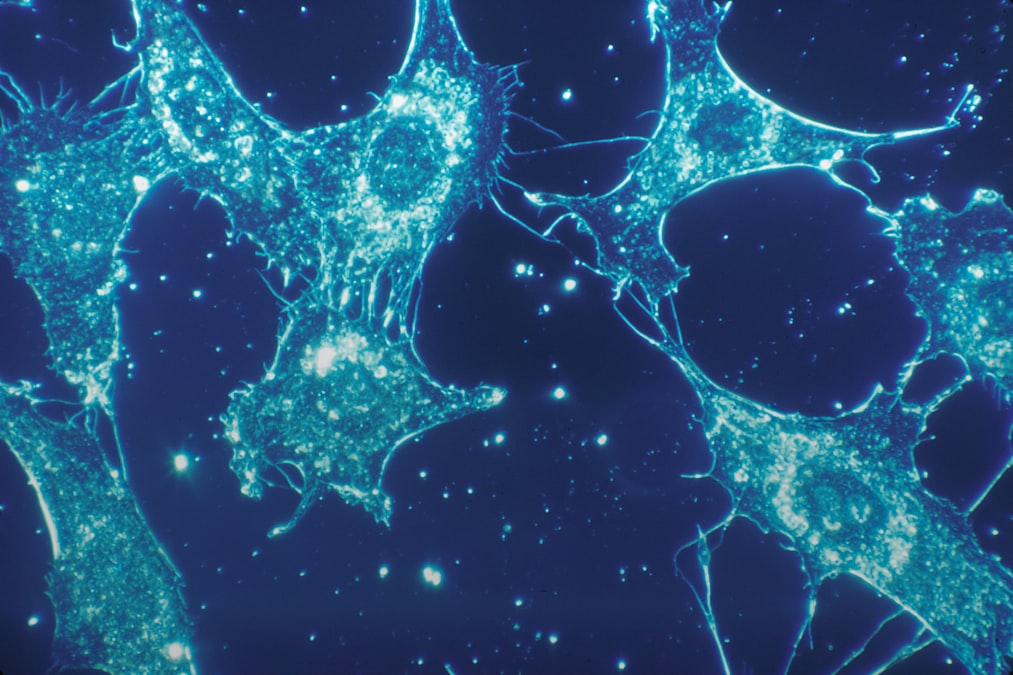
In 2015, in a lab at the University of California, San Diego, a biophysicist named Gürol Süel and his team were filming a biofilm of Bacillus subtilis when they noticed the whole colony pulsing. Not growing in a steady creep, the way biofilms are supposed to grow, but firing in waves, its interior and edges swapping states of activity on a rhythm you could set a clock to. The team, including Arthur Prindle, Jintao Liu, and Munehiro Asally, traced the pulses to a potassium ion channel called YugO, and published the result in Nature under a title that undersold what they had found: bacteria, sitting still on a plate, were talking to each other electrically across distances of a millimeter or more, using a signaling mechanism borrowed from the same ion channel family your neurons use to fire.
Nobody expected this from bacteria. Electrical excitability was supposed to be a trick multicellular organisms invented, something nervous systems needed and single cells did not. What Süel’s lab showed is that a biofilm, a dense mat of genetically identical cells stuck together in a self-made matrix, behaves less like a colony of independent agents and more like a single electrically coupled tissue. The bacteria on the outside of the mat and the bacteria buried in the middle are, in effect, wired together. And the reason they wired themselves together turns out to be mundane and completely logical: they were starving, and the wiring was the fix.
How you catch a bacterium in the act of firing
The technical problem the Süel lab had to solve first was how to see voltage changes in something as small and opaque as a bacterial cell. They used a dye called Thioflavin T, ordinarily deployed by biochemists to detect amyloid protein aggregates, and found that it also reports on membrane potential in living bacteria, lighting up when a cell is polarized and dimming as it depolarizes. Under time-lapse microscopy, a growing biofilm treated with the dye stopped looking like a static mass and started looking like tissue under an EEG. Waves of depolarization swept from the nutrient-starved interior of the colony outward to its edges, then reversed, over and over, with a period measured in tens of minutes to a couple of hours.
The channel responsible, YugO, is a potassium channel, structurally related to the potassium channels in your own neurons but doing a very different job on a very different clock. A neuron fires in a millisecond and the signal travels down an axon at meters per second. A Bacillus subtilis biofilm fires on the order of minutes and the wave crawls across the colony at roughly micrometers per second. It is the same basic electrochemical trick, an ion rushing across a membrane and changing the local voltage enough to trigger the same rush in the next cell over, just run at a pace suited to bacterial metabolism instead of animal reflexes.
The same ion channel machinery, running on a completely different clock.
The problem this solves is a traffic jam, not a thought
Why would a biofilm need this at all. The answer Süel’s group worked out, in a companion 2015 paper in Science led by Jintao Liu, comes down to a resource fight inside the colony. Cells on the biofilm’s outer rim have direct access to glutamate and ammonium in the surrounding medium. Cells buried in the interior do not, and as the colony grows, the periphery consumes nutrients fast enough to starve the cells at the core. Left unmanaged, that would kill the interior outright.
Instead, the potassium wave acts as a stress signal. When interior cells run low on nutrients, they release potassium ions, which depolarize their neighbors, which release more potassium, propagating outward until the entire biofilm’s peripheral cells receive the message and temporarily throttle their own growth. That pause lets nutrients diffuse deeper into the mat before the outer cells resume consuming them. The oscillation repeats as the imbalance rebuilds. It is a crude but effective load-balancing system, cells at the edge periodically stepping back so cells in the middle do not starve.
Cells on the outside share the pain of cells they cannot even see.
That framing matters because it tells you what kind of “communication” this is. It is not information processing in the sense a neuroscientist would recognize. It is closer to a thermostat network than a conversation, a distributed mechanism for balancing metabolic load across a structure too large for diffusion alone to equalize quickly. But a thermostat network spanning thousands of genetically identical cells, built from the same electrochemical parts list evolution used for animal nervous systems, is still a striking discovery about how far bioelectric coordination reaches down the tree of life.
The signal reaches past the biofilm’s own borders
Follow-up work extended the finding in a direction that surprised even people inside the field. A 2017 paper in Cell, led by Jacqueline Humphries with Süel and collaborators, showed that the potassium signal radiating from a Bacillus subtilis biofilm attracts other, unrelated bacterial species, including motile cells of Pseudomonas aeruginosa, which swim toward the potassium gradient the way they would swim toward a nutrient source. The biofilm’s internal electrical housekeeping was leaking a signal that other organisms had evolved to read and exploit or avoid.
A separate line of work, including a 2018 Science paper from Joseph Larkin and colleagues in the same lab, examined how the physical architecture of a biofilm determines whether a signal can travel across it at all. Electrical waves in these colonies do not always propagate cleanly. They percolate, meaning the density and connectivity of cells has to cross a threshold before a signal fired on one side of the mat can reliably reach the other. Below that threshold, the biofilm behaves as isolated patches rather than a coordinated whole. That detail matters for anyone hoping to eventually control this behavior from the outside, because it means the geometry of a biofilm, not just its chemistry, governs how it computes.
Where the skepticism belongs
Here is the part worth being blunt about. Headlines that followed this research in the popular press leaned hard on words like “bacteria think” or “biofilms have brains,” and that framing oversells what has actually been shown. There is no evidence of memory, learning, or decision-making in the neural sense. The oscillation is a negative feedback loop tuned by natural selection to solve a resource allocation problem, not a computation performed for its own sake. Comparing it to a nervous system is useful for building intuition about the ion channel mechanism, and dangerous if it implies cognition.
There is also a translation gap that the field has not closed. Almost everything described here comes from Bacillus subtilis colonies grown on defined agar media in a lab, a tidy experimental system chosen because it is easy to image and genetically tractable. Real-world biofilms, the ones that colonize catheters, lung tissue in cystic fibrosis patients, dental plaque, or industrial pipes, are usually multi-species, structurally messier, and living in far less controlled chemical environments. Whether the same potassium-wave mechanism operates, and operates the same way, in those settings has not been established with the same rigor. The organism of choice was picked for experimental convenience, and biology has a long history of discoveries in convenient organisms turning out to be partial stories once tested elsewhere.
| Feature | Neuronal signaling | Biofilm electrical signaling |
|---|---|---|
| Primary ion carrier | Sodium, calcium, potassium | Potassium (YugO channel) |
| Signal speed | Meters per second | Micrometers per second |
| Timescale of a pulse | Milliseconds | Minutes to hours |
| Functional purpose | Information transmission, computation | Metabolic load balancing across the colony |
Why an electroceuticals reader should care about pond scum
The reason this belongs in a publication about bioelectronic medicine rather than only microbiology journals is the target it hands drug developers. Biofilms are the reason chronic infections are so hard to clear. Bacteria inside a biofilm can tolerate antibiotic concentrations hundreds of times higher than the same species growing freely in solution, and a meaningful share of that tolerance is not genetic resistance at all, it is a physiological state the colony enters collectively. If that collective state depends on coordinated electrical signaling through a specific potassium channel, then blocking that channel, or scrambling the wave with an externally applied electric field, becomes a plausible way to break the biofilm’s defenses without needing a new antibiotic molecule at all.
That is still a hypothesis rather than a therapy. Nobody has run a clinical trial jamming biofilm potassium signaling in a human infection. But the mechanistic logic is the same logic that built the entire field of bioelectronic medicine around the vagus nerve: find the electrical signal an organism uses to coordinate itself, and you have a lever that does not require a new pharmacological compound, just the right frequency and the right target. The vagus nerve work found that lever in a mammal. S&uuel;’s lab found something structurally similar sitting inside an organism with no nervous system whatsoever.
The deeper claim, the one that outlasts any single paper, is that excitable ion channel signaling did not wait for neurons to be invented. It was already available in single-celled life, doing metabolic bookkeeping long before it got repurposed for thought. The open question is not whether bacteria are thinking, they are not. It is how many other collective behaviors in biology, in tissues that have nothing to do with brains, turn out to run on the same electrochemical parts list, just wired for a slower and humbler job.