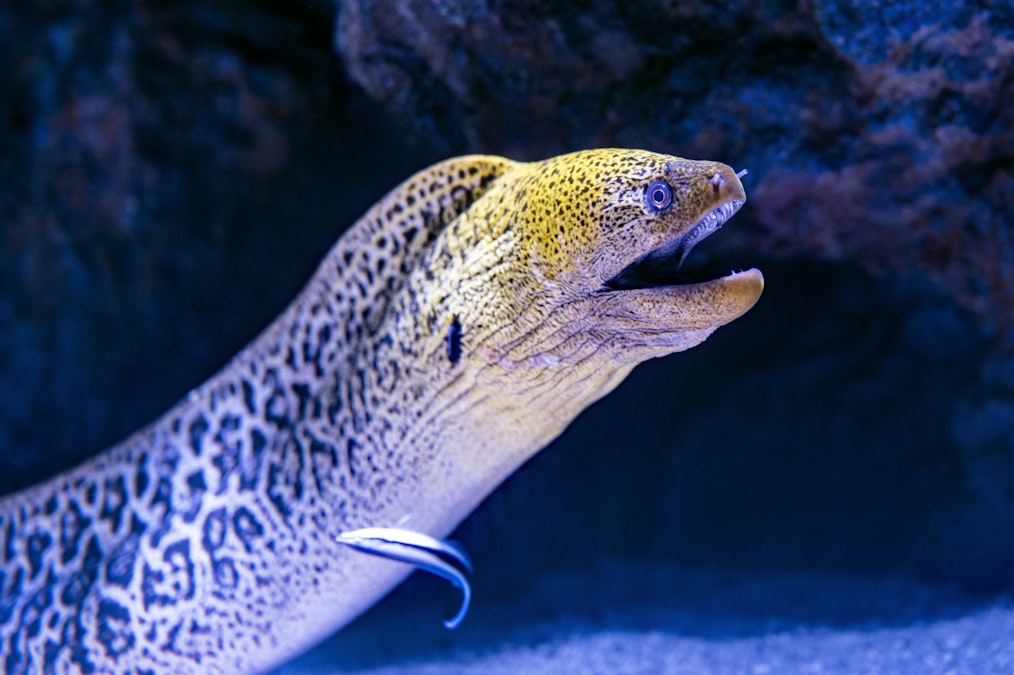
Photo by David Clode on Unsplash
The electric eel is one of the most extraordinary electrical organisms on Earth—capable of generating discharges exceeding 860 volts, enough to stun a horse or power a string of LED lights. But the eel is not merely a biological curiosity. Researchers studying its electrical architecture are upending assumptions about how biological systems generate and manage power, with implications that reach from materials science to the design of implantable medical devices.
How the Eel Builds Its Voltage
The electric eel is not actually an eel at all—it is a knifefish, more closely related to catfish than to true eels. Its body, which can exceed two meters in length, is approximately 80% dedicated to its electrical organs. Three distinct organs—the Main organ, Hunter’s organ, and Sachs’ organ—run the length of the animal and contain tens of thousands of specialized cells called electrocytes. These flattened cells, derived from muscle tissue during development, have abandoned contraction as their primary function. Instead, they generate electricity.
Each electrocyte operates like a biological battery cell. The cell maintains an unequal distribution of ions across its membranes: sodium and potassium concentrations inside and outside the cell create a resting potential of approximately 85 millivolts. When the eel initiates a discharge, nerve signals simultaneously activate sodium channels on one face of each electrocyte while keeping the other face quiescent. Sodium ions rush into the cell through the activated face, generating a transient voltage spike of about 150 millivolts across that membrane. Because thousands of electrocytes are arranged in series—like batteries stacked end-to-end—their voltages add together. The result is the kilovolt-scale pulses that make the electric eel’s discharge unique in the animal kingdom.
The timing precision required to achieve this is remarkable. For the voltages to add constructively rather than cancel out, every electrocyte in the series must fire within microseconds of each other. The eel’s nervous system achieves this through a network of specialized neurons that compensate for differences in axon length—neurons connecting to distant electrocytes have thicker, faster-conducting axons, ensuring that signals arrive simultaneously regardless of the distance they travel. This is a biological solution to a problem that engineers call synchronization, and the elegance of the eel’s approach continues to inform research in neural circuit design.
Hunting Strategies and Prey Control
The electric eel’s discharge repertoire is more sophisticated than early researchers appreciated. Vanderbilt University biologist Kenneth Catania’s work over the past decade has revealed that the eel uses its electrical output not just to stun prey, but to actively manipulate it. At close range, the eel can deliver high-frequency pulse doublets that trigger involuntary muscle contractions in hidden prey—essentially using remote electrical stimulation to make concealed fish twitch and reveal their location. The technique exploits the same physiology underlying the defibrillator: brief, high-voltage pulses delivered across motor nerve tissue cause synchronous muscle contraction regardless of the animal’s voluntary control.
This behavior—using bioelectricity as both a weapon and a sensory probe—positions the electric eel as a model system for understanding how electrical signals can interact with biological tissue at a distance. The eel’s pulses are carefully modulated in frequency, duration, and amplitude depending on context: low-amplitude, high-frequency pulses for electrolocation and communication; powerful double-pulse volleys for immobilizing prey; sustained high-voltage discharges for defense against large threats. This modulation is under active nervous system control, not a simple on-off switch.
Rewriting Physics: What the Eel Is Teaching Engineers
The eel’s ability to generate high voltages in a conductive aqueous medium—water, which rapidly dissipates electrical energy—has long puzzled physicists. How does a wet, flexible biological system achieve electrical performance that rivals engineered power supplies? The answer lies in the geometry of discharge, the impedance matching between electrocyte output and tissue resistance, and the eel’s behavioral adaptations that maximize power transfer to targets.
Researchers at the University of Michigan and elsewhere have used insights from electrocyte architecture to develop bio-inspired soft power sources. Hydrogel-based artificial electrocyte arrays—thin, flexible sheets of ion-exchange membranes separated by salt solutions—can generate brief voltage spikes mimicking the eel’s discharge pattern. These soft, transparent, biocompatible power sources could one day power implantable sensors without the rigid, potentially tissue-damaging batteries currently required. The eel demonstrates that high-voltage power generation is not inherently incompatible with soft, wet, living systems—a principle that is reshaping how engineers think about energy storage for medical devices.
The electric eel is also informing research into synthetic muscles and actuators. The electrocyte’s transformation from a muscle cell to a power-generating cell—accomplished during development through changes in gene expression rather than structural modification—suggests that the boundary between mechanical and electrical function in biological tissue is more plastic than previously assumed. Understanding the developmental biology of this transition could enable researchers to engineer tissue with programmable electrical properties, blurring the boundary between biological and electronic systems in ways that could transform both medicine and materials science.
A Blueprint for Soft Power Electronics
The electric eel’s legacy in engineering may ultimately be less about voltage and more about flexibility. Every implantable medical device currently on the market—pacemakers, cochlear implants, DBS systems, spinal cord stimulators—contains rigid components that create mechanical mismatch with the soft, dynamic tissue around them. The eel demonstrates that high-performance electrical systems can be built entirely from soft, wet, biocompatible materials. Applying that lesson to medical devices means revisiting fundamental assumptions about what implantable electronics need to look like. The eel has been solving this problem for 200 million years; engineers are just beginning to learn from the solution it found.
The electric eel’s legacy in engineering may ultimately be less about voltage and more about flexibility. Every implantable medical device currently on the market—pacemakers, cochlear implants, DBS systems, spinal cord stimulators—contains rigid components that create mechanical mismatch with soft, dynamic tissue. The eel demonstrates that high-performance electrical systems can be built entirely from soft, wet, biocompatible materials. Applying that lesson to medical devices means revisiting fundamental assumptions about what implantable electronics need to look like. The eel has been solving this problem for 200 million years; engineers are just beginning to learn from the solution it found. In parallel, eel-inspired soft generators are being explored for energy harvesting from bodily motion—converting the mechanical energy of breathing or walking into electricity that could power implanted sensors indefinitely, eliminating the battery replacement surgeries that currently limit device longevity.
Sources and Further Reading
- Catania, K.C. (2015). Electric eels use high-voltage to track fast-moving prey. PNAS, 112(31).
- Catania, K.C. (2019). The astonishing behavior of electric eels. Current Biology, 29(11).
- Schroeder, T.B. et al. (2017). An electric-eel-inspired soft power source from stacked hydrogels. Nature, 552.