Photo via Unsplash
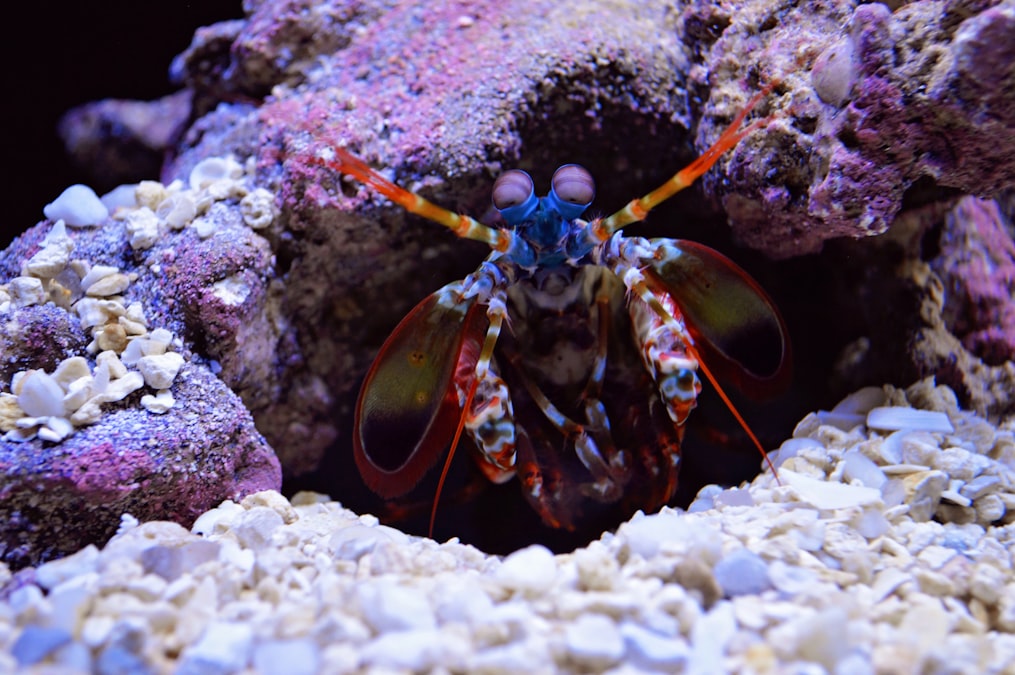
Mantis shrimp have 16 types of photoreceptors in their eyes—compared to three in humans—and can see into the ultraviolet and infrared. They can detect circularly polarized light, a capability found nowhere else in the animal kingdom. Their eyes move independently and can focus different regions of their visual field simultaneously. For decades, these facts positioned the mantis shrimp as the ultimate example of biological visual sophistication. Then researchers actually tested how well mantis shrimp discriminate colors, and the results were a surprise: they appear to be worse at distinguishing fine color differences than many animals with far simpler eyes. The mantis shrimp is teaching engineers to build better sensors not by maximizing discrimination, but by solving a completely different problem—fast, efficient classification of spectral information in complex, rapidly changing environments.
16 Channels, Not for Resolution—For Speed
The conventional assumption about visual systems with many receptor types is that they enable finer color discrimination—the ability to distinguish wavelengths that are close together. Behavioral experiments with mantis shrimp challenged this assumption. When tested on discriminating pairs of colors that differ by small amounts across the spectrum, mantis shrimp performed significantly worse than bees, which have only three photoreceptor types, and even some fish with four receptor types. They could not reliably distinguish colors that less-equipped animals handled easily.
The explanation that emerged is elegant and counterintuitive. Mantis shrimp do not use their 16 photoreceptor channels to perform the kind of opponent-process color comparison that underlies fine color discrimination in other animals. Instead, each channel serves as an independent threshold detector: when the output of a particular channel exceeds a threshold, that wavelength range is present. The mantis shrimp’s visual system essentially asks yes-or-no questions across 16 spectral bands simultaneously, generating a spectral fingerprint of the visual scene in a single pass rather than comparing channels against each other.
This approach trades discrimination resolution for processing speed. A comparison-based color system must compute ratios between channel outputs—a computationally expensive operation that takes time. A threshold-based system can classify a spectral fingerprint almost instantaneously, the moment channel outputs are available. For a predator that hunts by striking with appendages capable of delivering 1,500 newtons of force in 2.7 milliseconds—faster than a bullet leaving a gun—the speed advantage of rapid spectral classification over fine color discrimination may be decisive. The mantis shrimp has not failed to evolve a sophisticated color system; it has evolved a fundamentally different kind of color system optimized for its particular ecological challenge.
Circularly Polarized Light: A Private Communication Channel
The mantis shrimp’s ability to detect circularly polarized light is unique among animals and serves a function that goes beyond prey detection. The shells of some mantis shrimp species reflect circularly polarized light in patterns that are invisible to most predators and prey but visible to other mantis shrimp. This constitutes a private communication channel—a way to signal species identity, reproductive status, or territorial presence to conspecifics without broadcasting to the broader visual community.
The photoreceptors responsible for circular polarization detection in mantis shrimp are structurally distinct from those used for color detection. They are arranged in a spiral geometry that converts the helical oscillation of circularly polarized light into a detectable difference in receptor activation—a biological implementation of a quarter-wave retarder, the optical element used in engineered polarimeters for the same purpose. The biological version is accomplished through the precise orientation of photoreceptive membranes within the cell, without any rigid optical element—a soft-matter solution to a problem that engineers typically address with crystalline materials.
Engineering Lessons: Parallel Classification Over Serial Comparison
The mantis shrimp’s spectral fingerprinting architecture is directly applicable to engineering challenges in remote sensing, medical imaging, and materials inspection. Conventional hyperspectral imaging systems capture hundreds of wavelength bands and apply sophisticated machine learning algorithms to classify materials or detect specific targets from the resulting data. The processing pipeline is computationally intensive and creates latency that limits real-time applications.
The mantis shrimp model suggests an alternative: design sensor arrays with channels specifically tuned to the spectral signatures of target objects, and classify directly from threshold detection rather than from full spectral analysis. This approach requires more upfront knowledge about what the sensor is looking for—the equivalent of the mantis shrimp’s evolutionary tuning of its photoreceptors to the spectral properties of its prey and conspecifics—but enables real-time classification with minimal processing overhead. Several research groups are developing neuromorphic imaging sensors based on this principle for applications in cancer tissue detection, where specific tissue types have characteristic spectral reflectance properties, and in autonomous vehicle sensing, where rapid classification of road surface conditions from spectral data has safety implications.
The mantis shrimp also has much to teach about robustness. Its 16-channel spectral fingerprinting system maintains classification accuracy across a wide range of illumination conditions—in the sun-dappled, spectrally variable shallow marine environment where it lives—without requiring the computational normalization steps that engineered systems need to remain stable across changing light conditions. The biological solution builds illumination robustness into the receptor architecture itself, through mechanisms including receptor adaptation and pupillary control, that are still being fully characterized. Understanding these mechanisms at the biophysical level is an active research priority for groups working on robust artificial vision systems.
The mantis shrimp’s visual system is also beginning to inform the design of medical imaging devices. Conventional endoscopes capture broad-spectrum white light reflected from tissue, leaving the spectral information needed to distinguish tissue types largely unexploited. Hyperspectral endoscopes that add wavelength-selective detection can, in principle, distinguish cancerous from normal tissue based on spectral reflectance differences—without the need for biopsy or contrast agents. The mantis shrimp model—fast spectral fingerprinting using threshold detection rather than full spectral analysis—is particularly relevant here, where real-time classification during a procedure is essential and computational latency translates directly into procedural time. The ancient visual architecture of a marine crustacean may ultimately contribute to earlier, faster, less invasive cancer detection in human patients.
The mantis shrimp has spent hundreds of millions of years refining a visual system optimized for its specific ecological demands. Engineers are just beginning to appreciate how much that optimization diverges from human visual intuition—and how much it has to teach about building sensors that are fast, efficient, and robust in complex natural environments.
Sources and Further Reading
- Thoen, H.H. et al. (2014). A different form of color vision in mantis shrimp. Science, 343(6169).
- Marshall, N.J. et al. (2007). Courtship displays in mantis shrimps. Philosophical Transactions of the Royal Society B.
- Daly, I.M. et al. (2016). Dynamic polarization vision in mantis shrimps. Proceedings of the Royal Society B.