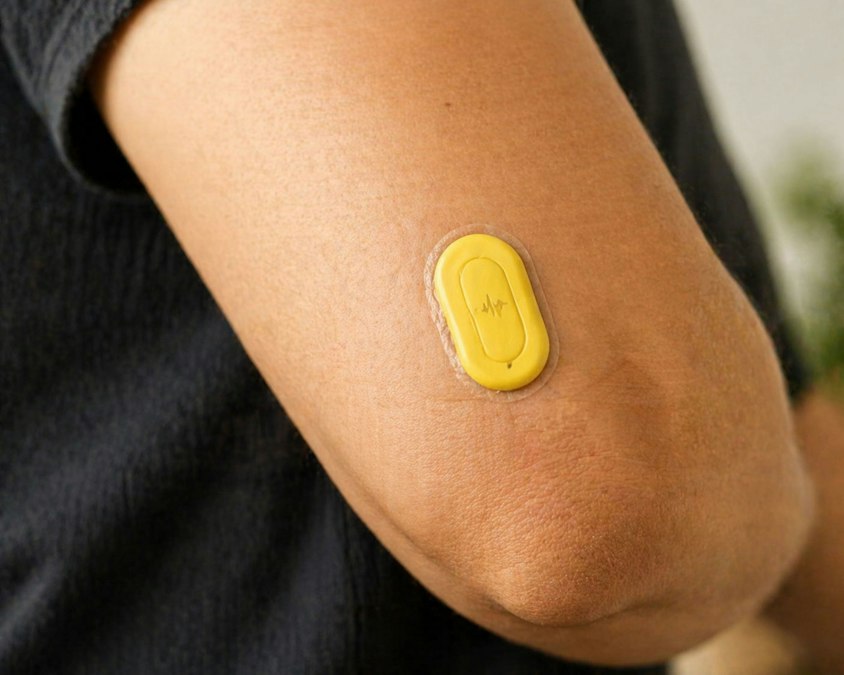
Stick a piece of gold mesh thinner than a human hair onto someone’s forearm, and it looks like a temporary tattoo a kid would get at a county fair. That is the point. I have handled these patches, and the first thing that surprises you is how little they feel like medical equipment. No gel, no wires trailing to a cart, no elastic straps digging into skin. Just a translucent film that wrinkles and stretches exactly the way skin does, because the interconnects underneath are cut into serpentine shapes that absorb strain instead of fighting it. What is new, as of the last two years of work coming out of labs like Nanshu Lu’s at the University of Texas at Austin, is that this same patch can now pull three completely different physiological signals out of the body at once: the electrical rhythm of the heart, the electrical chatter of the brain, and the electrical twitch of muscle. Not sequentially. Simultaneously, from the same piece of skin.
That sounds like a small engineering flex until you understand why it took over a decade to get there. Cardiac, neural, and muscle signals have been individually recordable from the skin’s surface since the era of vacuum-tube EKG machines. Putting all three on one patch, reading them cleanly at the same time, without one signal drowning out the others, is a different problem entirely.
Why Nobody Had Combined These Signals Before
Electrocardiogram signals from the skin run in the range of a few millivolts. Electromyogram signals from active muscle can spike higher. Electroencephalogram signals from the scalp, the ones that matter for sleep staging or seizure detection, sit down in the microvolt range, sometimes two or three orders of magnitude weaker than the cardiac signal riding on the same patch of skin. Try to record all three through a shared reference electrode and the heart’s electrical activity bleeds into every other channel. Engineers call this crosstalk, and it is the reason clinical monitoring has historically meant three separate systems on three separate parts of the body: a Holter monitor strapped to the chest, an EEG cap bristling with gel electrodes on the scalp, and adhesive EMG pads on a limb. Nobody wears all three set-ups on the same day unless they are in an ICU or a sleep lab, wired into three machines that were never designed to talk to each other.
Heart, brain, and muscle speak in different volumes. Recording them together means solving three noise problems at once.
The multimodal e-tattoo work solves this less through cleverer chips than through cleverer geometry and signal processing. The patches use frequency-division and spatial-filtering tricks to separate overlapping signals mathematically after they are captured together, plus electrode layouts positioned to weight each modality differently depending on placement. A patch on the neck or chest reads mostly cardiac signal with muscle artifact filtered out. A patch behind the ear or on the forehead, where EEG researchers have known for years that surface potentials are readable without breaching the skull, pulls brain signal with the heartbeat subtracted as a nuisance variable rather than treated as the target. Put multiple patches from the same family of hardware on a single subject and stream the data through one wireless receiver, and you get simultaneous ECG, EEG, and EMG without a hospital-grade multiplexer the size of a shoebox.
The Materials Trick Predates the Signal Trick
None of this works without a materials science lineage that goes back to a 2011 paper in Science by Dae-Hyeong Kim, John Rogers, and colleagues, then at the University of Illinois, working with Todd Coleman at UC San Diego on the neuroscience side and Yonggang Huang on the mechanics. That paper, titled simply “Epidermal Electronics,” demonstrated gold filaments patterned into wavy, serpentine traces on a thin elastomer film that could stretch by double-digit percentages without cracking, because the strain gets absorbed by the geometry of the wire rather than the wire itself.
The electronics don’t stretch. The wiring between them does.
That single insight, that you can decouple rigid silicon components from a stretchable substrate by giving the interconnects somewhere to bend, is the foundation under almost every skin-conformal sensor built since. Rogers moved his lab to Northwestern in 2016 and founded what is now the Querrey Simpson Institute for Bioelectronics, and much of the epidermal electronics translational work that followed, commercial products included, traces back through people who trained in that lineage. Roozbeh Ghaffari, who worked with Rogers as a graduate student, went on to cofound MC10 Inc, a Cambridge, Massachusetts company that commercialized a version of this technology under the name BioStamp starting around 2011. MC10 struggled to find a durable clinical business model despite genuinely good hardware, and the company wound down around 2021, with assets and IP scattering to other ventures. Ghaffari later cofounded Sibel Health, a Northwestern spinout that built the ANNE sensor system now used for continuous vital sign monitoring in neonatal intensive care units, replacing tangles of wired leads on fragile newborn skin with a pair of adhesive patches.
Sibel’s ANNE system is a genuine clinical success story, but it monitors heart rate, respiration, and temperature. It does not touch the brain. Getting EEG-quality signal onto the same kind of conformal, stretchable substrate is a harder problem, because scalp hair interferes with skin contact and because the signal itself is so much weaker. Nanshu Lu’s group at UT Austin has spent years on graphene-based tattoo electrodes specifically to push into that territory, publishing work on cuffless blood pressure monitoring through pulse transit time measured across two conformal patches, and more recently on patches that read EEG from the forehead and hairline without gel or scalp preparation. Stacking that neural capability onto the same wireless readout architecture used for cardiac and muscle signal is the step that produces a genuinely multimodal tattoo, one patch family, one receiver, three organ systems.
What This Is Actually Good For
The obvious clinical use case is drowsy driving and fatigue detection, where a single research question, is this person’s brain disengaging while their heart rate and neck muscle tone stay superficially normal, requires exactly this kind of simultaneous multimodal read. Sleep labs are another clear target. Right now a polysomnography study means a patient sleeping under a web of a dozen wired sensors in an unfamiliar bed, which by itself distorts the sleep architecture researchers are trying to measure. A handful of adhesive patches that a patient could apply themselves at home, feeding data to a phone overnight, would produce cleaner data precisely because it feels less like being monitored.
Epilepsy monitoring benefits in a similar way. Long-term video EEG for seizure characterization currently requires a hospital admission with a scalp cap that has to be reapplied by a technician every day or two as electrode gel dries out. A tattoo-style patch that stays adherent for multiple days and simultaneously logs muscle activity, useful for distinguishing seizure type by whether convulsive muscle activity accompanies the abnormal brain signal, shortens what is currently an expensive inpatient stay into something closer to an outpatient wearable study.
Where the Skin Patch Still Loses to the Needle and the Implant
None of this competes with implanted neural interfaces, and it should not be framed as though it does. Synchron’s Stentrode, developed under Tom Oxley, threads electrodes through the vasculature to sit against the motor cortex and records signal quality that no surface patch will ever match, because bone and scalp tissue attenuate and blur neural signal before it reaches the skin. Surface EEG, tattoo-based or not, cannot resolve individual neuron spikes. It reads population-level electrical summation, which is enough for sleep staging or seizure detection but nowhere near enough for the kind of fine motor cursor control that groups following Krishna Shenoy’s work at Stanford have demonstrated with penetrating electrode arrays. The tattoo and the implant are not competing products. They are solving different problems at different points on a tradeoff curve between signal fidelity and how much of your body you are willing to open up to get it.
| Device type | Invasiveness | Modalities at once | Typical wear duration |
|---|---|---|---|
| Multimodal e-tattoo | None, skin surface | ECG, EEG, EMG concurrently | Days, adhesive-limited |
| Holter monitor | None, adhesive leads | ECG only | 1 to 2 weeks |
| Clinical EEG cap | None, gel electrodes | EEG only, high channel count | Hours, reapplied for multi-day studies |
| Synchron Stentrode | Endovascular implant | Motor cortex signal only | Permanent, post-surgical |
The honest limitation of the tattoo approach right now is adhesion and power, not signal processing. Skin sheds, sweats, and stretches in ways that degrade electrode contact over days, and every wireless version of this hardware still needs either a battery small enough to disappear under the patch or a near-field power link that limits range to a few centimeters from a reader coil. Nobody has yet shipped a version of this that a patient wears for two weeks unattended the way they would a Holter monitor today. That is an adhesive chemistry and battery problem more than a bioelectronics one, and it is the kind of unglamorous engineering that tends to take longer than the flashy multimodal signal processing that gets the papers published.
The hard part left is not reading three signals at once. It’s keeping the patch stuck for two weeks.
What convinces me this direction matters is not the multimodality by itself but what it implies about where physiological monitoring is heading structurally. For seventy years, adding a new signal to a patient meant adding a new box, a new set of wires, a new piece of adhesive real estate on an already crowded body. The tattoo model inverts that. One conformal substrate, one wireless link, and the constraint becomes how much signal-processing cleverness you can extract from a shared piece of skin rather than how many machines you can physically fit on a patient. The clinical bottleneck for continuous multimodal monitoring is about to stop being sensor hardware and start being adhesive science and battery-free power delivery, which means the next five years of progress in this field will be won by materials chemists as much as by neuroscientists.
Credit: Salahuddin Ahmed on Unsplash