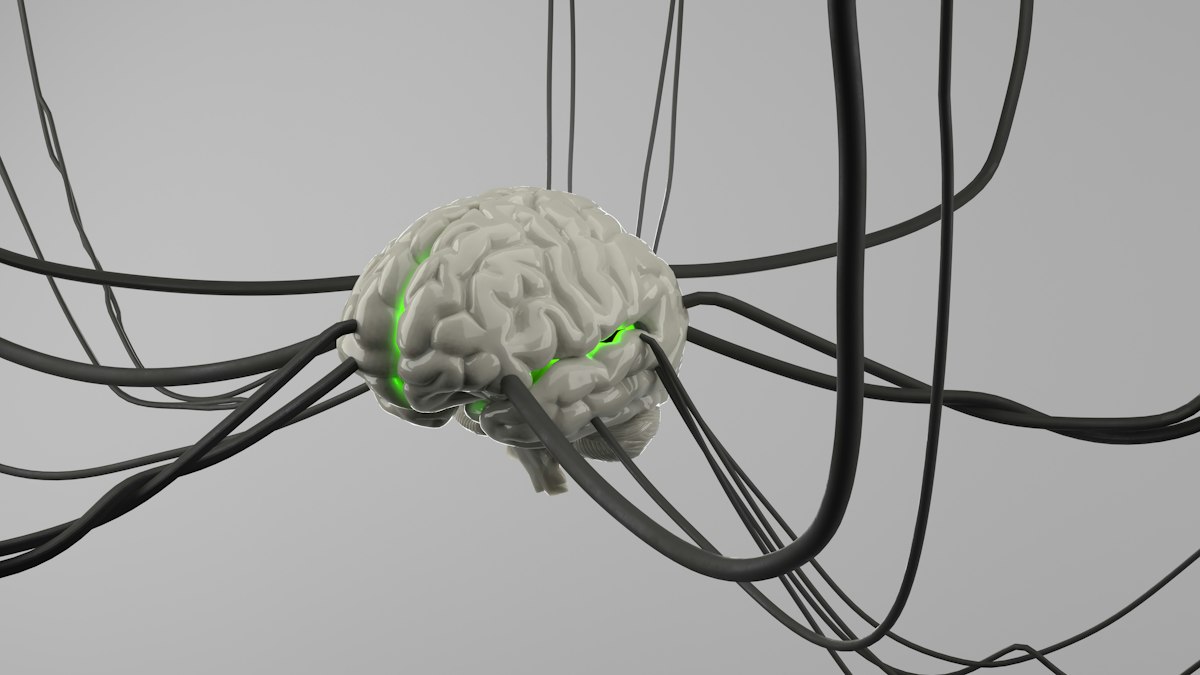
In 2019, DARPA put out a call that had nothing to do with sick people. The agency’s Next-Generation Nonsurgical Neurotechnology program, N3 for short, wanted a brain interface a healthy soldier could wear without surgery, something that could read neural signal well enough to let a person fly a drone swarm with intention alone. Teams at Rice University under Jacob Robinson, Johns Hopkins Applied Physics Lab, Battelle, and Teledyne all took contracts. Nobody in that program was paralyzed. Nobody had epilepsy or treatment-resistant depression. The target population was fit, healthy, and already capable of doing their jobs. The interface wasn’t meant to restore anything. It was meant to add.
For two decades, bioelectronic medicine has been a therapy category: vagus nerve stimulators quieting seizures, spinal cord stimulators letting paralyzed patients stand, deep brain stimulation pulling people out of decades-long depressive episodes. That story has a clean moral shape. Something is broken, electricity fixes it, insurance eventually pays for it. DARPA’s program doesn’t have that shape. It is the moment the field admitted, out loud and with a federal budget line, that the same electrodes built to repair a nervous system work just as well on one that was never broken. That is the pivot point this piece is about, and I don’t think the field, or the public, has caught up to what it means.
Therapy Built the Wires, and Enhancement Wants to Borrow Them
The vagus nerve stimulator got FDA approval for epilepsy in 1997 and for depression in 2005. Deep brain stimulation has been approved for Parkinson’s since 2002, and researchers including Helen Mayberg and, later, Sameer Sheth at Baylor College of Medicine have spent two decades refining subcallosal cingulate DBS for depression that doesn’t respond to anything else. These are hard-won, clinically bounded interventions, tested in trials against real disability. Nobody serious argues the epilepsy patient shouldn’t have the implant.
The trouble starts one step over, where the same devices get proposed for people who are not sick, just suboptimal. Anjan Chatterjee, a neurologist at the University of Pennsylvania, gave this category a name back in 2004: cosmetic neurology, borrowed from cosmetic surgery, describing the use of brain interventions to push a normal brain toward some preferred state rather than to fix a diagnosed deficit. He was writing about stimulant drugs and memory pills at the time. The framework maps onto bioelectricity just as well. Direct-to-consumer transcranial and vagal stimulation devices are already sold for focus, mood, and sleep, outside any FDA therapeutic claim, to people who have nothing wrong with them by any clinical measure. The hardware doesn’t know the difference between a patient and a customer.
Therapy asks a nervous system to work again. Enhancement asks it to work differently.
That distinction sounds tidy until you try to enforce it. A soldier using N3 to fly a drone faster is functioning better, by any operational definition. A depressed patient with a DBS implant tuned slightly past the point of symptom relief, into a state of durable good mood, is also functioning better. Where is the line supposed to sit? Regulatory agencies built their entire approval apparatus around treating diagnosed conditions. They have no settled apparatus for evaluating a device whose entire purpose is to make a healthy person more capable, because until recently no one was building those devices for market.
The Restoration Line Keeps Moving, and the Industry Is Moving With It
Look at where the money actually sits. Synchron’s Stentrode threads through the jugular vein into the brain’s motor cortex without open skull surgery, aimed squarely at paralysis, and it carries an FDA Breakthrough Device designation. Blackrock Neurotech’s Utah Array has been implanted in research subjects since the early 2000s, largely for restoring movement and communication in people with spinal cord injury or ALS. Neuralink put its N1 implant into its first human patient in January 2024, also framed around restoring function, movement and communication, for people with paralysis. All three companies describe their current clinical work in restorative language.
But listen to how their founders talk about the horizon. Elon Musk has said publicly, more than once, that Neuralink’s longer aim is a general brain-machine symbiosis, not limited to disease. That is not a hidden agenda. It is stated business strategy: build the therapy first, get the safety data, get the reimbursement pathway, then widen the aperture. Gregoire Courtine’s spinal stimulation work at EPFL, which let paralyzed patients walk again after complete spinal cord injury, sits comfortably in the restorative category today. Nothing about the underlying epidural stimulation technology prevents someone from asking, in a decade, whether the same interface could make an uninjured spine faster or more resistant to fatigue. The hardware roadmap and the enhancement roadmap are the same roadmap, running about five years apart.
| Program or Device | Stated Target | Current Status |
|---|---|---|
| Synchron Stentrode | Paralysis, motor restoration | FDA Breakthrough Device, early feasibility trials |
| Neuralink N1 | Paralysis, stated long-term general augmentation | First human implant, January 2024 |
| Blackrock Neurotech Utah Array | Paralysis, ALS, communication | Research use since early 2000s |
| DARPA N3 | Healthy operators, non-surgical read/write | Research-phase contracts awarded 2019 |
Neural Data Is the New Genome, and Nobody Has Settled Who Owns It
Nita Farahany, a law professor at Duke, has spent the better part of a decade arguing that the signals coming off a nervous system deserve their own category of legal protection, a concept she calls cognitive liberty, laid out at length in her 2023 book “The Battle for Your Brain.” Her argument is simple and hard to dismiss: your genome tells someone what you might become, but your neural signal tells someone what you are thinking, feeling, and attending to right now. Consumer wearables already capture attention and emotional-arousal proxies through EEG and galvanic skin response. A closed-loop implant capable of reading mood in order to correct it is also, structurally, a device capable of reporting that mood to whoever holds the data pipeline.
Chile got there before the rest of the world did on paper. In 2021 its congress amended the constitution to explicitly protect neural data and brain activity as a fundamental right, the first country to do so. UNESCO followed in 2021 with a recommendation on the ethics of neurotechnology, non-binding but influential. The United States has nothing comparable at the federal level. A device implanted to treat depression today generates a continuous stream of biomarker data about that patient’s neural state, and the terms governing who can access, sell, or subpoena that stream are set by whatever the device manufacturer’s data policy says, not by any neurorights statute.
Your genome describes what you might become. Your neural signal reports what you are, right now.
Enhancement raises the stakes on this because enhancement users are, by definition, not patients under a clinician’s care. A consumer who buys a mood-optimizing bioelectric wearable has signed a terms-of-service agreement, not informed consent overseen by an institutional review board. The legal protections that exist around clinical neural data mostly evaporate the moment the same signal gets collected outside a treatment context.
The Deaf Community Already Fought This Exact War
Long before anyone was arguing about brain implants, the cochlear implant forced this fight into the open, and it is worth remembering how badly the first round went. When cochlear implants scaled in the 1980s and 1990s, a large part of the Deaf community, organized partly out of Gallaudet University, rejected the framing entirely. They did not experience deafness as a deficit needing an electrical fix. They experienced it as a language and a culture. The device that hearing medicine called restorative, a meaningful share of the affected population called an erasure. Gallaudet’s 1988 Deaf President Now protests weren’t about cochlear implants directly, but they came out of the same argument: who gets to define what counts as a life worth having, the person living it or the clinician holding the device.
Cochlear implants taught medicine that “restoration” is a claim, not a fact.
Bioelectric enhancement is about to relearn that lesson at a much larger scale, because the category of people it will touch is not a single community with decades of shared political organizing. It is everyone who can afford the device. Access to Synchron’s or Neuralink’s implants today runs through clinical trial enrollment and, eventually, insurance codes tied to a diagnosis. Access to a future enhancement version will run through disposable income. A nervous system upgrade that costs as much as a car will sort people the way private schooling and elite tutoring already do, except the trait being purchased is attention, mood stability, or processing speed, encoded directly into neural tissue rather than taught. That is a harder inequality to legislate against than tuition, because it will arrive wrapped in medical legitimacy, sold by the same companies and using the same trial infrastructure that gave paralyzed patients their hands back.
What a Real Line Would Have to Look Like
I don’t think the answer is a ban, and I don’t think it’s a shrug either. A workable line has to be drawn at consent and reversibility, not at the word “enhancement,” because that word will always be contested. A depressed patient consenting to DBS knows their baseline is causing measurable harm and has exhausted other options; that consent is informed by suffering and by a clinician bound to a duty of care. A healthy person buying a mood-optimization implant off a website has neither. The honest regulatory move is to require the same tier of oversight, real trials, adverse event reporting, explicit data ownership terms, for enhancement devices that non-clinical bioelectric products currently escape by never claiming to treat a disease. Chile’s neurorights amendment and UNESCO’s recommendation point at this, but neither has teeth yet in the market that actually matters, the U.S. consumer device space where most of this will first reach ordinary people.
The nervous system doesn’t distinguish a therapeutic pulse from an enhancing one. The distinction lives entirely in why the pulse was sent and who decided to send it. Bioelectric medicine spent thirty years building the tools to answer a broken nervous system’s call for help. Those same tools are now capable of answering a call nobody made, from a nervous system that was never asking for anything. The open question isn’t whether that upgrade will get built. DARPA already funded it, Neuralink already said it out loud, and the hardware trajectory from restoring to exceeding is not something any company has shown interest in stopping. The open question is whether the legal and ethical scaffolding around neural data and consent gets built before the first fully healthy customer signs up, or after.
Credit: Bhautik Patel on Unsplash