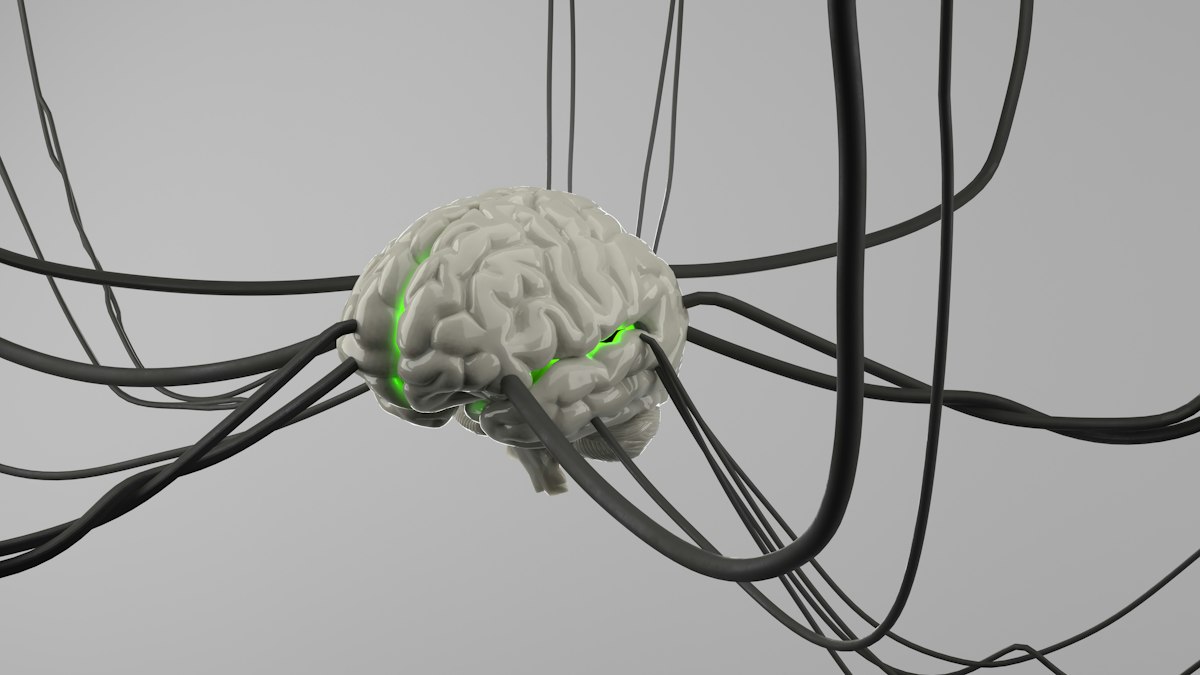
In December 2021, a team at Cortical Labs in Melbourne took roughly 800,000 living neurons, grown in a dish and wired to a silicon electrode array, and taught them to play Pong. They called it DishBrain. The neurons weren’t simulated. They were real cortical cells, harvested from mouse embryos and, in later versions, derived from human stem cells, and they learned to move a paddle faster than a reinforcement learning algorithm trained on the same task. Nobody claimed the dish was conscious. But nobody could fully explain, either, what category of thing it had become. Not a computer. Not quite a brain. Something in between that didn’t have a name yet.
That ambiguity is the real story of the next few decades in this field, and most of the coverage misses it by focusing on the hardware. The headlines are about chips: Synchron’s stentrode threading through a blood vessel to read motor cortex, Neuralink’s N1 implant, Blackrock Neurotech’s Utah array. All real, all important. But the more consequential shift is conceptual, not mechanical. Computing is stopping being a thing silicon does to biology from the outside, a tool applied to a body, and becoming a thing that happens inside biological substrate itself, using the body’s own electrochemical grammar. The question in the headline isn’t rhetorical. It has a specific, uncomfortable answer, and it’s worth sitting with.
The body was never not a computer
Start with the premise most people get wrong: that computing “becoming biological” is a novel event. It isn’t. Every neuron in a human cortex is already performing something close to a computation, integrating thousands of weighted inputs and firing or not firing based on threshold logic that predates digital computing by about 600 million years. Every T cell deciding whether to attack is running a decision tree built from membrane voltage and calcium flux. The heart’s sinoatrial node is a pacemaker circuit that Intel would be lucky to design with such fault tolerance. Michael Levin’s lab at Tufts has spent over a decade showing that even non-neural cells, in planaria and frog embryos, use bioelectric gradients to store and process positional information, essentially running a slow, voltage-based program that tells a flatworm how many heads to grow back. The body has always been biological computing. What’s new is that engineers have finally gotten fluent enough in the body’s native language, voltage, ion gradients, spike timing, to write to it and read from it on purpose.
This reframes what’s actually happening with neural interfaces. Kevin Tracey’s work on the inflammatory reflex at the Feinstein Institutes showed that the vagus nerve carries a legible, controllable signal that downregulates TNF-alpha production, and that a device can dial that signal up or down like a volume knob. Gregoire Courtine’s team at EPFL used epidural electrical stimulation, synchronized to intended movement, to let paralyzed patients walk again, restoring a Lumbar spinal signal the body already knew how to use. None of this is computing imposed on biology. It’s computing recovered from biology, using silicon as a prosthetic for a circuit that already existed and had gone quiet.
The body was never not a computer. The silicon just finally learned to read the native language.
Organoid intelligence is the part nobody has a framework for
DishBrain is not an isolated curiosity. Thomas Hartung’s group at Johns Hopkins has been building what the field now calls “organoid intelligence,” brain organoids, lab-grown clusters of human neural tissue derived from induced pluripotent stem cells, wired to multi-electrode arrays and trained on simple tasks. The pitch is partly practical: biological tissue is absurdly efficient at certain computations compared to silicon. A human brain runs on roughly 20 watts. Training a large language model can consume the energy equivalent of hundreds of households running for a year. If even a sliver of that efficiency gap can be captured by growing neural tissue purpose-built for computation rather than cognition, the incentive to pursue it is enormous, and the money is already moving that direction through academic consortia and a handful of startups.
Here is where the philosophy stops being abstract. An organoid is not a person. It has no sensory organs, no body, no developmental history that would give it anything like a self-model. But it is made of the same cells, using the same electrochemical mechanisms, that in a different configuration produce human experience. Nobody has a principled, non-arbitrary line that says “a cluster of 800,000 cortical neurons learning Pong is definitely not having an experience, but 80 billion cortical neurons in a skull definitely is.” That line doesn’t exist in neuroscience right now. It’s not that scientists are hiding the answer. It’s that the question was never operationally defined, because until recently nobody could build the intermediate case.
Hartung and others have been explicit that this needs ethical infrastructure built in parallel with the capability, not after it. The Novartis-funded, since-restructured field of organoid research already has precedent for caution here, mostly from debates over cerebral organoids used to model disease. But disease modeling organoids aren’t optimized to compute. Organoid intelligence platforms are explicitly selected and trained for information processing, which is a different ethical category even if the tissue looks identical under a microscope.
The interface problem is really an identity problem
Move from organoids to implants and the question doesn’t get easier, it just changes shape. Tom Oxley’s company, Synchron, has implanted its Stentrode in patients with severe paralysis, letting them control a cursor, send texts, and operate smart home devices using motor cortex signals picked up through a blood vessel rather than an open-skull procedure. Synchron’s approach deliberately avoids penetrating brain tissue, trading some signal resolution for a dramatically lower-risk procedure, a bet that scalability beats precision for now. Neuralink has taken the opposite bet: penetrating electrode threads, higher channel counts, more invasive surgery, in exchange for richer signal. Both are chasing the same underlying goal, which is a stable, long-duration, high-bandwidth channel between intention and machine.
What gets lost in the Neuralink-versus-everyone-else framing is that bandwidth isn’t the hard problem anymore. Krishna Shenoy’s work at Stanford, before his death in 2023, helped establish that decoding algorithms could translate imagined handwriting into text at speeds approaching 90 characters per minute, a result that stunned the field in 2021. The decoding is good and getting better fast. The hard problem is durability: keeping an electrode’s signal quality stable in brain tissue for years, not months, as the immune system encapsulates foreign material in glial scarring. That’s a materials science and immunology problem as much as a computing one, which is itself a tell that the categories are dissolving. You can’t solve the “computing” half of a brain-computer interface without solving a biological host-response problem first.
The hard problem was never bandwidth. It’s getting biological tissue to tolerate a foreign object for a decade.
And once the channel is stable and bidirectional, meaning the device can write to the brain as well as read from it, the identity question becomes unavoidable. A cochlear implant already does this in a narrow sense: it doesn’t just transmit information to the brain, the brain learns to treat the implant’s electrical code as sound, rewiring itself around the device. Multiply that by motor control, by mood regulation through deep brain stimulation for depression and OCD, which Helen Mayberg’s research helped pioneer at Emory and later Mount Sinai, and you have hardware that isn’t just assisting cognition. It’s becoming a constitutive part of how certain functions are produced. At what point does the device stop being a tool a person uses and start being a component of who that person is?
A quick comparison, because the approaches genuinely differ
The table below is a simplification, but it’s worth laying the major bioelectronic and biological computing approaches side by side, because the ethical weight of each differs enormously even though journalism tends to flatten them into one story.
| Approach | Example | What’s biological | Core ethical tension |
|---|---|---|---|
| Vascular neural interface | Synchron Stentrode | Reads existing motor cortex signal | Data ownership, device dependency |
| Penetrating electrode array | Neuralink N1 | Reads and writes to cortical tissue | Identity, agency, long-term tissue response |
| Peripheral nerve stimulation | Vagus nerve stimulators, Feinstein Institutes research | Modulates existing autonomic circuit | Consent for chronic, always-on modulation |
| Organoid computing | Cortical Labs DishBrain, Johns Hopkins organoid intelligence | Living neural tissue as the processor itself | Moral status of lab-grown tissue that computes |
Regulation is built for devices, not for hybrids
The FDA’s regulatory apparatus for neural devices was built around a model where the device is clearly separable from the patient: implant it, evaluate its safety and efficacy, monitor for failure, replace or remove as needed. That model holds up reasonably well for Synchron and Neuralink, which is why both have been able to secure Investigational Device Exemption status and run human trials, Synchron’s COMMAND trial and Neuralink’s PRIME study among them. It holds up far less well once the “device” is partly or wholly biological, grown rather than manufactured, and capable of adapting its own structure in response to training, the way DishBrain’s neural culture rewired its connectivity to get better at Pong.
A silicon chip doesn’t change its physical architecture while you use it. A living neural network does, constantly, through synaptic plasticity. That means a biological computing system approved today could, in a meaningful sense, be a structurally different system a year from now, having learned things and reorganized connections in ways the original safety review never evaluated. Device regulation assumes a static artifact with a known failure mode. Biological computing produces an artifact that is, by design, a moving target. Nobody currently regulates for that, because until organoid and hybrid systems reached this level of capability, nobody needed to.
What the “becoming biological” framing gets right and wrong
The framing in this piece’s own headline deserves scrutiny, because it implies a one-way transition, computing migrating from silicon into flesh. That’s too clean. The more accurate picture is convergence from both directions. Silicon engineers are building chips that mimic neural architecture directly, IBM’s TrueNorth and Intel’s Loihi are both neuromorphic processors designed around spiking, event-driven computation because it’s dramatically more power-efficient than traditional von Neumann architecture for certain tasks. Meanwhile biologists are building neural tissue that behaves more like an engineered circuit, trained with reward signals, read out through electrode arrays, optimized for a task rather than grown to be a person. The two camps are converging on the same design principles, sparse, event-driven, massively parallel, low-power, from opposite starting materials. That convergence is the real trend, and it’s a stronger, stranger claim than “computers are turning into brains.” It’s that the most efficient way to compute anything complex increasingly looks like a nervous system, regardless of what it’s built from.
The question isn’t whether computers will become biological. It’s that the best computing already looks like a nervous system, built from either material.
The counterargument worth taking seriously is that none of this implies anything resembling consciousness or moral patienthood, and that treating a Pong-playing neural culture as an ethical puzzle is premature anthropomorphizing. That’s fair as far as it goes. Nobody has evidence that an organoid suffers. But the absence of evidence isn’t the same as evidence of absence, and the honest position is that neuroscience doesn’t yet have a test that could distinguish the two cases even in principle. Building increasingly sophisticated biological computing substrates while that test doesn’t exist is not reckless, exactly. It’s just moving faster than the field’s ability to answer its own central question.
The real answer to “what happens when computing becomes biological” is that the categories we used to sort “tool” from “organism” stop doing useful work, and nobody has built the replacement vocabulary yet. A Stentrode patient texting with motor cortex signals is clearly still a person using a tool. A cortical organoid learning to track a ball is clearly not a person. Somewhere between those two, probably sooner than the regulatory and ethical infrastructure is ready for it, something will exist that doesn’t fit either description cleanly, a system that computes using living neural tissue, adapts its own structure, and can’t be fully explained as either device or subject. The field doesn’t need a bigger breakthrough before that happens. It needs a better word.
Credit: Bhautik Patel on Unsplash