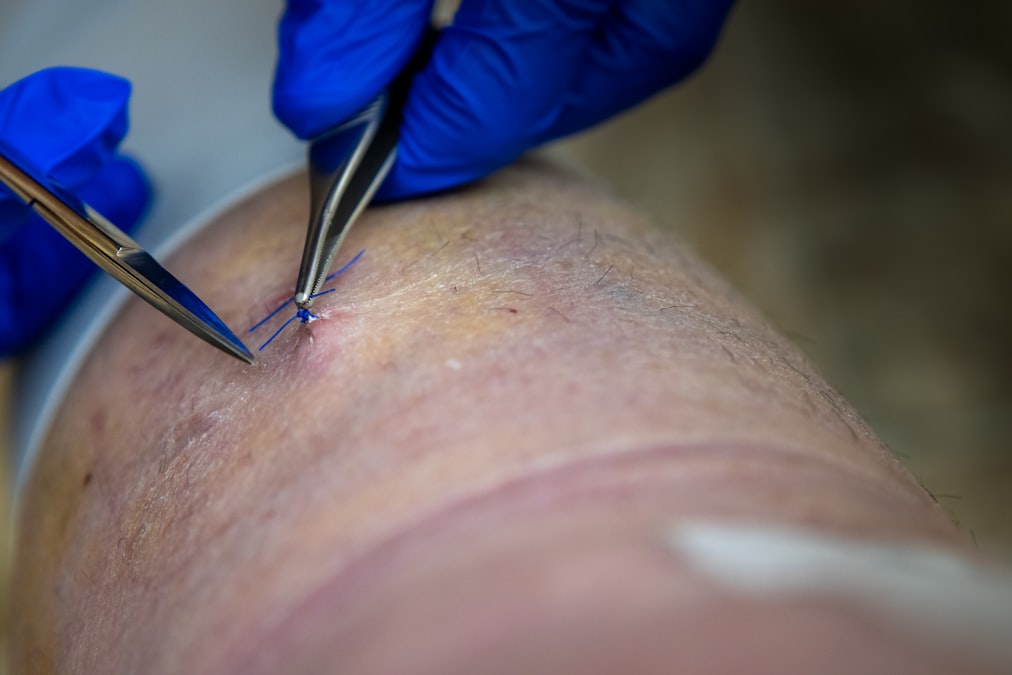
Photo via Unsplash
When you cut your finger, something electrical happens before the bleeding even stops. The disruption of skin creates an immediate voltage difference—a wound current—that acts as one of the body’s most primitive signaling systems. This bioelectric wound signal predates the nervous system by hundreds of millions of years and remains one of the most powerful guides for tissue repair.
Intact skin maintains a transepithelial potential (TEP) of roughly 25-100 millivolts, with the inside of the skin more negative than the outside. This voltage is generated and maintained by active ion transport—cells constantly pumping sodium, potassium, and chloride ions to create an electrical gradient across the epithelium. When skin is damaged, this gradient collapses at the wound site, creating a lateral electric field pointing toward the injury.
Cells respond to these electric fields through a process called electrotaxis or galvanotaxis. Skin cells, immune cells, and even bacteria can sense field strengths as low as a few millivolts per millimeter and orient their movement accordingly. Keratinocytes—the primary cells responsible for closing a wound—migrate toward the cathode (the wound center) with remarkable directional fidelity when exposed to electric fields matching those found in healing wounds.
How Skin Becomes a Battery
The transepithelial potential is not a static charge—it is a dynamic equilibrium maintained by continuous active transport across a living membrane. The outer layer of the epidermis, the stratum corneum, is largely impermeable to ions; the living layers below it, from the stratum granulosum down to the basal layer, are leaky. Sodium ions enter epithelial cells passively through sodium channels on their apical (outer) surface and are actively pumped out at the basolateral (inner) surface by Na+/K+-ATPase. Chloride ions follow a parallel pathway via CFTR and other chloride channels. The net result is a continuous electrogenic pump that maintains the inside of the skin at a negative potential relative to the surface—essentially turning the whole skin into a thin, sheet-like battery.
The magnitude of this potential varies by body region and by species. Human skin TEP measurements typically run between 25 and 75 millivolts, but corneal epithelium—one of the most studied epithelial tissues for bioelectric research—can reach 30-40 millivolts, and amphibian skin, which has been a model system since Luigi Galvani’s eighteenth-century experiments, maintains potentials of 50-100 millivolts. These are not trivial voltages: across a hundred-micrometer-thick epithelium, 50 millivolts corresponds to an electric field of 500 V/m—comparable to the fields encountered near high-voltage power lines, and far more than enough to influence the behavior of charged proteins on cell surfaces.
When a wound disrupts this epithelial battery, current flows out of the low-resistance wound gap, through the tissues beneath, and back into the intact epithelium surrounding the wound—a circuit sometimes called the wound current loop. Measurements using vibrating probe electrodes have directly visualized this current flowing outward from fresh wounds in skin, cornea, and regenerating amphibian limbs. The resulting lateral electric field in the tissue adjacent to the wound—the field that cells actually sense—is oriented with its positive pole at the wound margin and its negative pole (cathode) at the wound center, pointing inward toward the breach in the epithelial battery.
The Cellular Response: Migration, Proliferation, and Polarity
The electrotactic response of keratinocytes has been studied in controlled in vitro systems for decades. Cells placed in a Galvanotaxis chamber—a flat tissue culture dish through which a precisely controlled DC electric field can be applied—orient and migrate toward the cathode with striking consistency. At field strengths of 50-150 mV/mm, which approximate endogenous wound fields, human keratinocytes redirect their migration within minutes and maintain cathodally directed movement for hours. The directional response is dose-dependent: stronger fields produce faster and more precisely directed migration.
The mechanism begins at the cell surface. Electric fields exert forces on charged and polar membrane components, causing electrophoretic redistribution of receptors and lipids within the plane of the membrane. Key signaling molecules—including the epidermal growth factor receptor (EGFR), phosphatidylinositol 3-phosphate (PIP3), and various integrins—redistribute to the cathodal-facing side of the cell within minutes of field application. This asymmetric distribution activates PI3K-Akt signaling preferentially on the leading edge, stabilizing that edge and directing cytoskeletal assembly toward the cathode. The lagging edge, by contrast, activates PTEN, the phosphatase that opposes PI3K, reinforcing polarity by destabilizing protrusions on the trailing side.
Immune cells join the electrical choreography. Neutrophils—the first responders to tissue injury—show robust electrotaxis, migrating cathodally (toward the wound) at field strengths well below those of endogenous wound fields. Macrophages follow, with their electrotactic direction shifting as they transition from pro-inflammatory (M1) to pro-regenerative (M2) phenotypes during the normal progression of wound healing. Even endothelial cells, which must grow into the wound to vascularize new tissue, respond to electric fields by elongating and migrating in the direction of angiogenic advance. The wound electric field appears to function as a master orchestrator, coordinating the spatial behavior of multiple cell types across a tissue that may span centimeters.
From Basic Biology to Clinical Application
The clinical relevance of bioelectric wound healing has been recognized—fitfully—for over a century. Galvanic currents were applied to wounds by nineteenth-century physicians long before anyone understood why they worked. Modern clinical electrical stimulation for wound healing uses a variety of waveforms—pulsed electromagnetic fields (PEMF), high-voltage pulsed current (HVPC), and low-intensity direct current (LIDC)—with varying degrees of evidence supporting their efficacy. The Cochrane reviews of electrical stimulation for pressure ulcer healing have generally found modest positive effects, though trial heterogeneity makes definitive conclusions difficult.
The challenge is partly technological and partly conceptual. Most clinical devices deliver electrical stimulation through surface electrodes that create gross fields across the entire wound, rather than the precisely shaped lateral fields that nature generates. The wound electric field in vivo has a specific geometry—oriented laterally, pointing inward—and its spatial pattern changes as healing progresses. Devices that simply pass current between two electrodes flanking the wound do not replicate this geometry faithfully.
Next-generation approaches are addressing this gap. Bioelectronic wound dressings—flexible electronics embedded in wound contact materials—can deliver spatially patterned electrical stimulation that more closely mimics the endogenous field. Researchers at institutions including MIT, the University of Wisconsin, and several European centers have demonstrated prototype dressings with arrays of individually addressable electrodes that can be programmed to generate field patterns matching measured wound TEP distributions. In animal models, these devices accelerate re-epithelialization, reduce scar formation, and improve the organization of collagen deposition in healing dermis.
Perhaps most intriguingly, the wound electric field also influences gene expression in healing tissue beyond the immediate effects on cell migration. Exposure to physiological electric fields upregulates growth factor receptors, accelerates the secretion of matrix metalloproteinases needed for tissue remodeling, and suppresses inflammatory cytokine production in keratinocytes—effects that persist for hours after the field is removed. The electrical signal of injury is not just a GPS for migrating cells; it is a transcriptional regulator, a paracrine signal in electrical form, reshaping the entire healing program through a mechanism that began operating before multicellular life developed a nervous system to carry messages in any other way.
Sources and Further Reading
- Zhao, M. et al. (2006). Electrical signals control wound healing through phosphatidylinositol-3-OH kinase-gamma and PTEN. Nature, 442.
- Reid, B. et al. (2011). Wound healing in rat cornea: the role of electric currents. FASEB Journal.
- McCaig, C.D. et al. (2005). Controlling cell behavior electrically: current views and future potential. Physiological Reviews, 85(3).