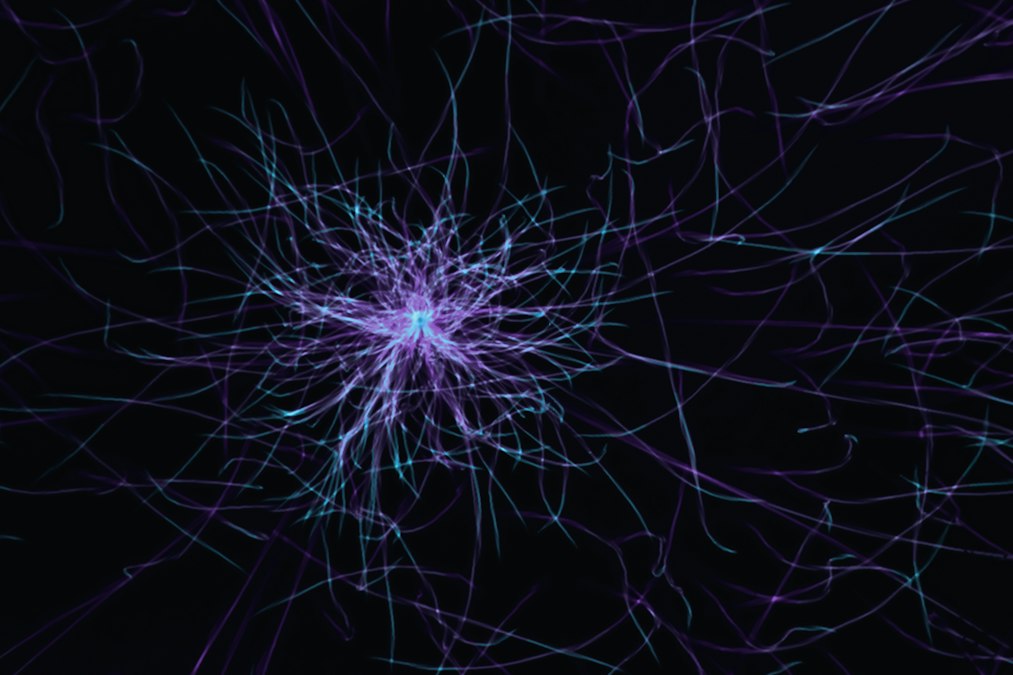
On January 13, 2020, a team from the University of Vermont and Tufts University published a paper in the Proceedings of the National Academy of Sciences describing something that had never existed before: a life form designed entirely inside a computer, then built out of living cells. The design came from an evolutionary algorithm running on a supercomputer, cycling through tens of thousands of virtual body plans made of simulated skin and heart cells, selecting for shapes that could move toward a target. The winning designs were handed to a developmental biologist named Douglas Blackiston at Tufts, who assembled them from frog embryo cells under a microscope. They named the results xenobots, after Xenopus laevis, the African clawed frog whose cells they used.
The headline at the time was “AI designs living robots.” That framing is true but it buries the more interesting fact. These machines don’t run on anything resembling code. There’s no genome edited, no logic gate installed, no instruction set. What actually drives a xenobot’s behavior, and what the AI had to learn to manipulate, is the pattern of electrical voltage sitting across the membranes of its cells. That’s the part worth sitting with. The computing industry spent seventy years building machines out of binary switches. Biology has been running a completely different kind of computation the entire time, and it’s taken until now for AI to get good enough to read and write it.
A Machine Designed a Life Form, and the Life Form Runs on Voltage, Not Code
Every cell in your body sits at a voltage, usually somewhere between negative 20 and negative 90 millivolts relative to its surroundings, maintained by pumps and channels that push ions like potassium, sodium, and chloride across the membrane. Neurons are famous for using rapid voltage spikes to fire signals down axons. What Michael Levin’s lab at Tufts has spent over two decades documenting is that nearly every cell type does something with voltage, just slower and quieter. Skin cells, gut cells, and cardiac cells all sit in bioelectric networks, connected to their neighbors through channels called gap junctions, sharing voltage information the way neurons share it, just without the drama of an action potential.
Levin’s earlier work on flatworms showed why this matters. Block the gap junctions in a planarian with a specific drug for a short window during regeneration, and the worm regrows with two heads instead of one, permanently, with descendants that keep regenerating two heads for generations, long after the drug is gone and with no change to the animal’s DNA. The anatomical instruction wasn’t stored in the genome. It was stored in the voltage state of the tissue, and once that state flipped, the pattern held.
Voltage, not sequence, was the memory that mattered.
Xenobots and their 2023 successor, anthrobots, are what happens when you take that discovery and hand the design problem to an AI instead of a lab technician nudging one variable at a time.
Why You Need an AI to Read a Language With No Dictionary
The genetic code has a dictionary. Three nucleotides map to one amino acid, and that table was fully worked out by the mid-1960s. Nothing like that exists for bioelectric patterning. There’s no fixed table mapping “this voltage pattern” to “this body part.” The same ion channel can push a cell toward becoming an eye in one tissue context and do something entirely different in another, depending on what its neighbors are signaling. It’s combinatorial, context-dependent, and the space of possible configurations is enormous. No biologist can hold that search space in their head.
That’s the actual reason the Vermont team, led by computer scientist Josh Bongard, used an evolutionary algorithm rather than hand-designing the xenobot shapes. Their system, described in the same 2020 PNAS paper with lead author Sam Kriegman, ran generation after generation of simulated cell clusters through a physics engine, scored them on how well they performed a task like directed movement, and let the better performers reproduce with small mutations. It’s the same basic logic Darwin described, compressed into a laptop-scale simulation running at a pace no living evolutionary process could match.
An algorithm can search a space no biologist would think to walk into.
What came out the other side wasn’t a machine built to a blueprint a human would have drawn. Some of the successful designs had oddly placed indentations or asymmetric cilia patches that turned out to work better than anything a human engineer had tried, because the algorithm wasn’t constrained by intuition about what a “sensible” body plan looks like. It was just hunting for whatever voltage-driven cellular arrangement got the job done.
The Human Version: Anthrobots and Where This Gets Uncomfortable
In 2023, a researcher in Levin’s lab named Gizem Gumuskaya, working across Tufts and Harvard’s Wyss Institute, published a paper in Advanced Science describing anthrobots, a successor to xenobots built not from frog cells but from adult human tracheal cells taken from airway tissue. Freed from the body and given the right culture conditions, these cells self-assembled into small multicellular clusters covered in cilia, tiny hairlike projections that beat in coordinated waves and push the whole cluster around a dish. Left alongside a scratch wound in a layer of cultured neurons, the anthrobots encouraged nerve cells to grow back across the gap.
Nobody programmed that repair behavior. It emerged from cells reverting to a kind of default collective coordination, the same bioelectric signaling machinery your body already uses during wound healing, just triggered outside the context of an intact organism. This is where the AI angle gets less about design and more about interpretation. The evolutionary algorithms used for xenobots proposed body shapes in advance. Anthrobots are closer to letting human cells write their own bioelectric configuration, with researchers using machine learning to classify and predict which resulting shapes are more likely to move, or heal, or cluster in particular ways after the fact.
That distinction matters for where this heads next. Design-first bioelectric AI, in the xenobot mold, points toward custom-built cellular machines for tasks like clearing microplastics or delivering drugs inside the body. Interpretation-first bioelectric AI, in the anthrobot mold, points toward diagnostics and regenerative medicine, reading a tissue’s voltage state to know what it’s about to become, or nudging it toward healing without cutting a single gene.
Where This Idea Oversells Itself
Here’s the honest limitation, and it’s worth being direct about it. “AI thinks in bioelectric patterns” is a compelling sentence and it is not, right now, a literal description of any working system. The AI in the xenobot and anthrobot work runs on ordinary silicon, in simulation, external to the living tissue. It designs or classifies bioelectric configurations. It does not run on them. Nobody has built a general-purpose processor that computes using membrane voltage the way a CPU computes using transistor states, and there’s a real argument that the metaphor breaks down at the hardware level: transistors are binary switches with two clean states, while bioelectric signaling is graded, noisy, and shaped by diffusion and chemistry in ways that resist the crisp abstraction binary logic depends on.
Levin himself has been careful about this in his own writing, describing bioelectric patterning as closer to a distributed problem-solving process among cells acting as agents with local goals, not a lookup table or an instruction set. Machine learning models are good at finding statistical regularities in that process. They are nowhere close to letting you specify an arbitrary target anatomy and reliably get it, the way you can specify a target output and get reliable results from a well-trained image classifier. Every demonstrated case so far, xenobots included, solves a narrow task: move toward a target, sweep loose particles into piles, close a wound gap. Nobody has built a bioelectric machine that generalizes across tasks the way a modern language model generalizes across writing prompts.
Two Computing Traditions That Are Starting to Notice Each Other
Bioelectric organism design isn’t the only place this convergence is showing up. In 2022, a company called Cortical Labs published work in Neuron, led by Brett Kagan, describing a system called DishBrain: roughly 800,000 living mouse and human cortical neurons grown on a multielectrode array, wired into a simplified version of the video game Pong through electrical stimulation as feedback. The neurons adjusted their firing patterns over training sessions and improved at returning the ball, using their own native electrical signaling as the entire computational substrate, no simulation involved.
Put next to the Tufts and Vermont work, a pattern comes into focus. Silicon computing separates hardware from software cleanly. These biological systems don’t allow that separation. The substrate, the memory, and the computation are the same physical process, cells maintaining and adjusting their own voltage states. AI’s role across both projects is the same: it’s the tool sophisticated enough to search, interpret, or train a system whose internal logic humans can’t write out by hand.
| System | Computing substrate | AI’s role | Maturity |
|---|---|---|---|
| Silicon CPU/GPU | Binary transistor switching | Runs on it, doesn’t design the hardware logic itself | Mature, ubiquitous |
| Neuromorphic chips (Intel Loihi, IBM TrueNorth) | Analog spiking circuits mimicking neurons | Engineered by chip designers to approximate neural dynamics | Research stage |
| Xenobots / anthrobots (Tufts, UVM) | Graded membrane voltage across living cell clusters | Evolutionary search designs form; ML classifies emergent behavior | Early proof of concept |
| DishBrain (Cortical Labs) | Live cortical neuron firing on an electrode array | Trains the biological system directly via feedback stimulation | Early proof of concept |
None of these four rows are the same technology, and conflating them is how you end up with breathless claims about “living computers” that overstate what’s actually running. But they share a direction of travel. Each one treats voltage-based, cell-level signaling as a computational resource worth building tools to access, rather than something to abstract away in favor of clean digital logic.
What You’re Actually Watching Happen
You’re not watching AI become biological, and you’re not watching biology become digital. You’re watching two very different information systems, one built on discrete binary switches and one built on continuous, self-repairing voltage gradients shared between living cells, get close enough that tools from one can start operating on the other. The xenobot pipeline didn’t teach silicon to think like a cell. It taught an algorithm to search a space of cellular configurations fast enough to find working answers a human never would have guessed. That’s a narrower, more useful claim than “AI thinks in bioelectric patterns,” and it’s also the one actually backed by a decade of Levin’s bench work and five years of AI-designed organisms built at Tufts and Vermont.
The open question isn’t whether this scales into some general bioelectric computing platform. It’s whether the field even wants that. A xenobot doesn’t need to generalize across tasks to be useful for targeted drug delivery or microplastic collection. A tissue doesn’t need a universal instruction set to be worth reading before you decide whether to amputate or regenerate it. The most likely future here isn’t AI learning to run on voltage instead of code. It’s AI staying exactly where it is, in silicon, getting steadily better at listening to a communication system that was never designed to be read by anything outside the body it evolved in.
Credit: Sandip Kalal on Unsplash