In February 2022, a man named Michel Roccati stood up and walked across a room in Lausanne, Switzerland, using nothing but his own legs and a stimulator implanted over his spinal cord. Roccati had a complete spinal cord injury. Not incomplete, not partial: the kind of injury that leaves no clinically detectable connection between brain and legs. He shouldn’t have been able to take a single step, let alone walk with the kind of alternating, weight-shifting gait that looks like actual walking instead of a marionette being yanked upright. What made it possible wasn’t a stronger current. It was timing.
That distinction, timing over strength, is the whole story of where spinal stimulation has gone in the last five years, and it’s a story most coverage of “electrical implants that let paralyzed patients walk” gets wrong. The current itself is not new. Researchers at UCLA and the University of Louisville have been running electrical current into the lumbosacral spinal cord since the early 2000s, and by 2011 a paraplegic man named Rob Summers was standing and moving his legs voluntarily under stimulation from Susan Harkema and Reggie Edgerton’s team. What’s changed since then isn’t the electricity. It’s the decision about when, exactly, to deliver it.
Tonic stimulation moves muscles. It doesn’t produce gait.
The first generation of epidural stimulators worked the way a dimmer switch works. Turn it on, set an amplitude and frequency, and the spinal circuits below the injury get a continuous background hum of current that lowers their threshold for activation. Patients could then use whatever voluntary drive they had left, or reflex-triggered patterns, to generate movement. It was genuinely remarkable work, and it rewired assumptions about what an “isolated” spinal cord below a complete injury can still do. But tonic, always-on stimulation has a ceiling. It doesn’t know whether a leg is in swing phase or stance phase. It just keeps humming, and the patient’s own residual system has to do the work of shaping that background excitability into an actual step.
Grégoire Courtine’s lab at EPFL, working with neurosurgeon Jocelyne Bloch at Lausanne University Hospital, built the alternative: a system that reads the intended phase of movement and fires precisely timed bursts at the specific motor pools that should be active at that instant. Their 2022 Nature Medicine paper, led by Andreas Rowald, described a paddle electrode called WISE with sixteen contacts arranged to target individual muscle groups in the legs and trunk, driven by software that reconstructs, moment to moment, where a patient is in the gait cycle. Flexors get stimulated during swing. Extensors get stimulated during stance. The spinal cord isn’t being buzzed into general readiness anymore. It’s being conducted.
The spinal cord isn’t being buzzed into readiness. It’s being conducted.
That distinction sounds academic until you watch the gait it produces. Open-loop tonic stimulation tends to generate movement that looks effortful and a little mechanical, understandably, since the patient is fighting the timing rather than riding it. The closed-loop, activity-dependent version produces something that reads, to a clinician’s eye, as walking. Not therapy-walking. Walking. Patients in the Lausanne cohort, including Roccati, were reported climbing stairs and navigating slopes within a single day of activation, and continued to improve over months of use, in some cases regaining stepping ability even with the stimulator switched off, evidence that the therapy was driving actual neuroplastic rewiring of surviving spinal circuits, not just providing a crutch.
The next loop closes at the brain, not the spinal cord
Reading gait phase from movement sensors is one kind of closed loop. In May 2023, Courtine and Bloch’s teams published a second, more radical version in Nature: a “digital bridge” connecting a brain implant directly to the spinal stimulator, tested in a patient named Gert-Jan Oskam, who had been paralyzed in a cycling accident in China in 2011. Oskam had electrode arrays recording cortical activity associated with intended leg movement. That signal was decoded in real time and translated into stimulation commands sent wirelessly to the epidural array over his spinal cord, restoring the natural chain of command: intention in the brain producing movement in the legs, with the injured segment of the spinal cord bypassed entirely rather than just excited in the background.
Oskam described being able to walk over uneven terrain and up ramps, functional movement that neither brain decoding alone nor spinal stimulation alone reliably produces on its own. The brain-spine interface is a research prototype, not a product, and it requires two separate implanted systems plus a decoding pipeline that has to be tuned to one person’s cortical signals. But it establishes the ceiling toward which the field is climbing: not a stimulator that helps you move, but a system that gets out of the way of the connection you already have and lets your own motor intent drive the output.
Twelve years between a cycling accident and a signal that let his own intention drive his legs again.
From a Lausanne lab bench to a regulatory filing
Research systems don’t reach patients on their own, and this is where ONWARD Medical enters the picture. The company, spun out of the Courtine and Bloch research program and headquartered in the Netherlands and Switzerland, has been building two parallel product lines: ARC-EX, a transcutaneous system that delivers stimulation through electrodes on the skin over the neck, and ARC-IM, the implanted epidural system descended directly from the WISE paddle work. ARC-EX received FDA marketing authorization in December 2024, aimed initially at improving hand and arm function in people with spinal cord injury, based on results from the Up-LIFT trial. That makes it the first FDA-cleared spinal cord stimulation system specifically indicated for spinal cord injury, and notably it got there with the noninvasive product first, not the implant.
ARC-IM, the closed-loop implanted system built for walking recovery, is further behind on the regulatory path, still generating clinical data toward a pivotal trial, but it’s the platform doing the more structurally interesting work: reading movement intent or gait phase and shaping stimulation output around it in real time, rather than delivering a fixed pattern and hoping the body adapts.
| System | Institution / Company | Loop type | Status |
|---|---|---|---|
| Louisville / UCLA epidural stimulation | University of Louisville, UCLA | Open loop, tonic | Research, since 2011 |
| WISE paddle array | EPFL / CHUV Lausanne | Closed loop, gait-phase triggered | Published 2022, Nature Medicine |
| Brain-spine digital bridge | EPFL / CHUV Lausanne | Closed loop, cortically driven | Published 2023, Nature, single patient |
| ARC-EX | ONWARD Medical | Transcutaneous, programmed | FDA cleared, December 2024 |
| ARC-IM | ONWARD Medical | Closed loop, implanted | Pivotal trial stage |
Rhythm is the therapeutic ingredient, not a side benefit
It would be easy to treat the “natural walking rhythm” framing as marketing polish on top of what is still, fundamentally, electricity applied to a spinal cord. I don’t think that’s right, and the clinical detail that convinces me is the persistence effect. Patients in the closed-loop trials have shown neurological recovery that outlasts the stimulation itself: improved voluntary movement and even some stepping ability with the device turned off, after months of activity-matched training. Tonic, unpatterned stimulation hasn’t produced that kind of carryover as reliably. The leading explanation is that timing the current to coincide with a patient’s own attempted movement recruits Hebbian-style plasticity, the same “fire together, wire together” principle that governs learning everywhere else in the nervous system. A spinal cord that gets stimulated in sync with intended movement seems to relearn the movement. A spinal cord that just gets buzzed on a fixed schedule mostly just gets buzzed.
That has a real clinical implication beyond gait speed on a lab treadmill. Autonomic function rides on the same circuitry. Several patients in the Lausanne trials reported improvements in bladder control, blood pressure regulation, and trunk stability, the unglamorous consequences of spinal cord injury that dominate patients’ daily lives far more than the ability to take ten steps under supervision. If closed-loop, phase-locked stimulation is doing something closer to retraining the spinal cord than to puppeteering it, those downstream autonomic gains make mechanistic sense in a way that pure current-strength explanations don’t.
What this doesn’t fix, and who it currently serves
None of this is a cure, and the honest version of this story has to say so. Every patient discussed here required a surgically implanted electrode array, months of supervised training, and continuous involvement from a specialized clinical team. The published cohorts are small. Chronic complete injuries with intact spinal cord tissue below the lesion, the population where this has worked best, are not representative of the full range of spinal cord injuries, many of which involve tissue damage too extensive for any electrode to work around. Chet Moritz’s group at the University of Washington and others working on noninvasive transcutaneous stimulation are betting that a meaningful slice of benefit can be delivered without surgery at all, trading some precision for accessibility, and ARC-EX’s FDA clearance suggests regulators are taking that trade seriously.
The honest counterargument is that “restores natural walking rhythm” is a headline built on a few dozen patients worldwide, not a therapy sitting in outpatient clinics. That’s fair. But the mechanism underneath the headline, timing stimulation to biological rhythm instead of overriding it with brute current, is not a one-off finding specific to gait. It’s a design principle, and I’d bet it shows up next in bladder control, in respiratory pacing, in every place bioelectronic medicine has been treating the nervous system’s clock as noise to drown out instead of a signal to synchronize with.
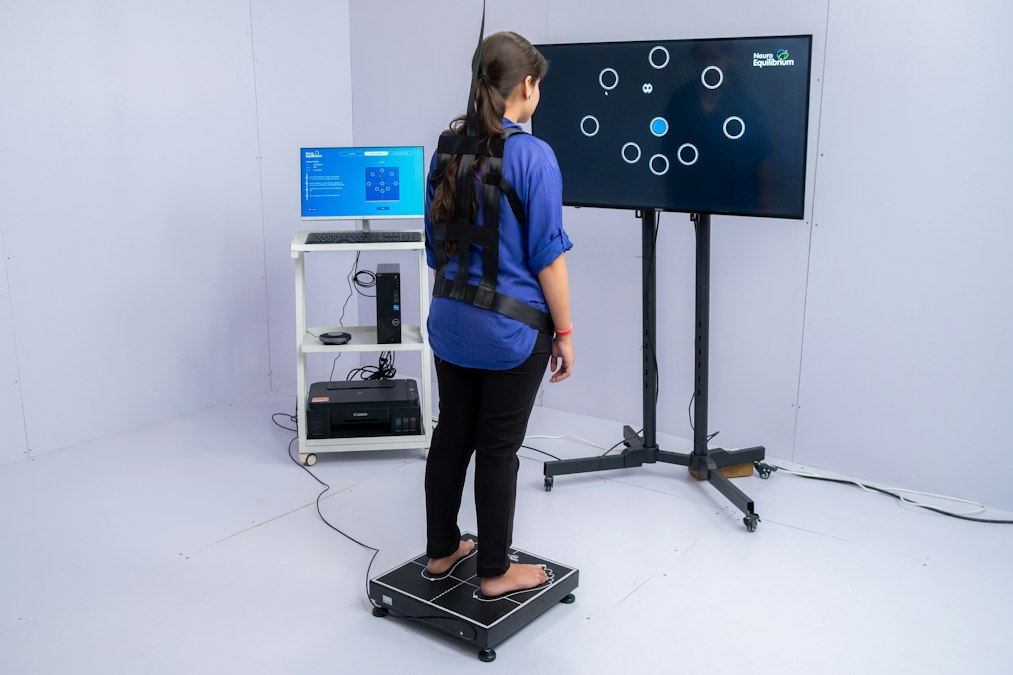
Credit: Neuro Equilibrium on Unsplash