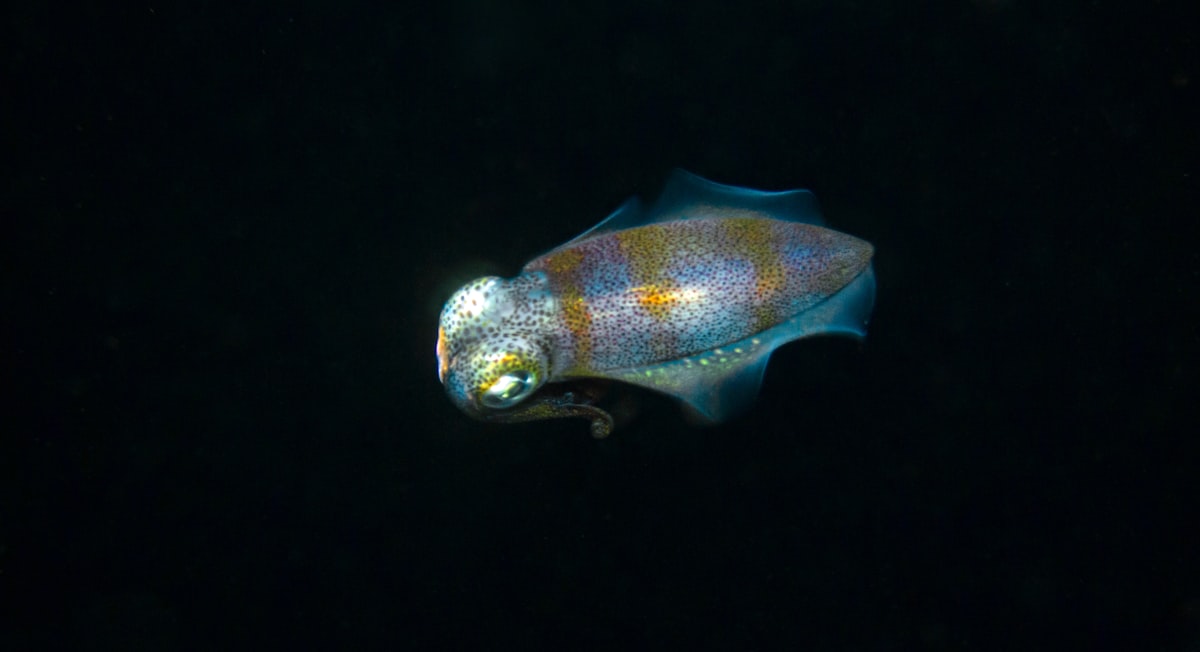
In 1988, on the sand flats off Oahu’s Coconut Island, Margaret McFall-Ngai waded into shin-deep water at night with a dip net and a headlamp, hunting an animal barely larger than a thumbnail. The Hawaiian bobtail squid, Euprymna scolopes, buries itself in sand by day and hunts by night, and when McFall-Ngai lifted one from the water it did something that would occupy the next three decades of her career. It glowed, faintly, from its underside, a cool blue-green light with no obvious source. There was no chemical she could see, no visible organ that looked like it belonged in a squid. What she was looking at was a bacterium, borrowed and rewired.
The light was not the squid’s own biochemistry. It came from Vibrio fischeri, a marine bacterium that the squid recruits fresh from seawater within hours of hatching and houses in a dedicated light organ inside its mantle. Left alone, a free-floating Vibrio fischeri cell produces no light at all. Packed into the squid’s crypts by the hundreds of millions, it does, using an enzyme called luciferase to oxidize a small organic molecule and release photons as a byproduct. McFall-Ngai and her longtime collaborator, the microbiologist Edward Ruby, spent the following years at the University of Hawaii and later at the University of Wisconsin-Madison establishing that this pairing, published in a landmark 1991 paper in Science, was one of the cleanest examples of animal-bacterial symbiosis ever described. But the deeper question, the one that turned the bobtail squid into a genuine model organism in developmental biology and immunology, was never just where the light came from. It was how an invertebrate with no control over its tenant’s chemistry manages to turn that light up, down, and off, on cue, every single night.
A Bacterial Bulb Wired Into an Animal Nervous System
The bobtail squid’s light organ sits in the center of its mantle cavity, tucked beside the ink sac, shaped roughly like a two-lobed heart. Each lobe contains epithelium-lined crypts that Vibrio fischeri colonizes almost immediately after the squid hatches, arriving from the surrounding seawater in a process so selective that of the hundreds of bacterial species in coastal Hawaiian water, only this one species successfully establishes residence. Once inside, the bacteria multiply until they reach a population dense enough to switch on their own luminescence genes, a phenomenon called quorum sensing that was first described in Vibrio fischeri in the 1970s by Kenneth Nealson and J. Woodland Hastings. Below a threshold density the bacteria stay dark. Above it, a signaling molecule called an autoinducer accumulates faster than it can diffuse away, each cell effectively counting its neighbors, and the whole population flips on in near-unison.
That gives the squid a light source it did not evolve the biochemistry to produce, but light production and light control turn out to be two separate problems, solved by two separate systems. The bacteria decide whether to glow. The squid decides how much of that glow anyone else gets to see, and it does that with tissue, muscle, and nerve, the same toolkit any animal uses to control any organ.
The Ventral Shutter That Turns Bacterial Glow Into Camouflage
Wrapped around the light organ’s core is a layered structure that functions less like a lamp and more like a camera. Behind the bacterial crypts sits a reflector made of iridophore cells, silvery and mirror-like, angled to bounce photons downward and outward through the squid’s translucent underside. In front of that, closer to the ventral surface, sits a lens-like structure and a muscular, pigmented screen that can spread across the organ or retract from it, functionally opening and closing like an aperture. This screen is not passive tissue. It is innervated directly by nerves running from the squid’s brain, carrying electrical signals that trigger the muscle fibers to contract or relax, adjusting how much of the reflected light escapes the animal’s body.
The bacteria decide whether to glow. The squid decides who gets to see it.
The behavioral logic behind this apparatus is called counterillumination, and it solves a specific predation problem. A bobtail squid hunting at night near the surface, lit from above by starlight or moonlight filtering down through the water column, casts a visible silhouette to any predator looking up from below. By matching the intensity and even the spectral quality of downwelling light with its own ventral glow, the squid erases its own shadow. Researchers studying the behavior, including work extending McFall-Ngai’s lab, found that squid recalibrate their light output as ambient moonlight changes across a single night and across lunar phases, brightening on clear, moonlit nights and dimming when cloud cover cuts the ambient light down. That calibration has to happen fast, faster than bacterial population growth could ever manage on its own, which is exactly why the muscular shutter matters. Quorum sensing sets the baseline. The nerve-and-muscle iris does the real-time adjustment.
Quorum sensing sets the baseline. The neural iris does the real-time adjustment.
An Eye Living Inside the Light Organ
For the shutter to work as a dimmer rather than a blunt on-off switch, the squid needs to know how bright its own light organ actually is. It cannot see the organ directly. Its camera-type eyes sit up near its head, aimed outward, not down into its own mantle cavity. The solution, described by Todd Oakley’s lab at UC Santa Barbara in research on extraocular photoreception in Euprymna scolopes, is that the light organ itself expresses opsins, the same class of light-sensing proteins used in eyes, embedded directly in tissue surrounding the bacterial crypts. The organ, in effect, watches itself glow.
This creates a closed feedback loop that looks a great deal like the control circuits engineers build for physical dimmer switches: a sensor reads output, compares it to a target, and adjusts a downstream actuator until the two match. In the squid, photons generated by Vibrio fischeri strike opsins in the surrounding tissue, that signal feeds into the local nervous circuitry controlling the muscular screen and reflector angle, and the aperture narrows or widens until the escaping light lands near whatever intensity the animal needs at that moment. Nobody has fully mapped the wiring between the light organ’s opsins and the nerves that move the screen, and that gap remains one of the more interesting open questions in cephalopod neurobiology. But the architecture, a self-monitoring light source with local sensory feedback, is not something biologists expected to find sitting inside a mantle cavity built to house a bacterium.
Every Dawn, the Squid Resets the Bulb
Counterillumination governs the light organ minute to minute. A slower cycle governs it day to day. Each morning around dawn, the bobtail squid expels the overwhelming majority of its Vibrio fischeri population back into the surrounding seawater, a process researchers call venting. Estimates from studies of the symbiosis put the fraction expelled at somewhere around ninety percent of the light organ’s bacterial population, purged in a single event tied to the animal’s circadian rhythm. The squid then buries itself in sand for the day, light organ mostly empty, and the surviving bacterial population regrows through the daylight hours, ready to reach quorum-sensing density again by the following night.
Jamie Foster, whose work has tracked circadian gene expression in the Vibrio fischeri symbiosis, has shown that this cycle runs on a genuine internal clock, not simply a reaction to light and dark in the environment. Spencer Nyholm’s research on the light organ’s immune architecture adds another layer: specialized blood cells called hemocytes patrol the crypts and appear to actively cull the bacterial population, meaning the squid is not a passive landlord waiting for bacteria to leave on their own. It is managing tenancy, actively thinning the population it will need to regrow by nightfall. Venting, hemocyte policing, and quorum sensing together set how many bacteria are available to glow at all. The neuromuscular shutter and the opsin feedback loop then decide how much of that available glow actually reaches the water.
| Control layer | Time scale | What it adjusts |
|---|---|---|
| Bacterial quorum sensing | Hours | Whether Vibrio fischeri produces light at all |
| Neuromuscular screen and reflector | Seconds | How much emitted light escapes the body |
| Extraocular opsin feedback | Continuous | Matches output to a target intensity |
| Dawn venting and hemocyte control | Daily | Bacterial population size available to glow |
A Chemical Light Source Wearing a Nervous System
What makes the bobtail squid unusual among bioluminescent animals is not that it glows. Plenty of marine life does, from anglerfish to countless species of dinoflagellates and deep-sea shrimp, most of them producing their own light through internal biochemistry with no outside tenant involved. The bobtail squid glows using a chemistry that belongs entirely to another organism, and then layers its own nervous system, its own muscle tissue, and its own sensory proteins on top of that borrowed reaction to make it useful. The light itself is bacterial. The control system is squid, built from the same electrical signaling that governs muscle contraction and sensory transduction anywhere else in the animal kingdom.
That distinction matters for how biologists think about where bioelectric control begins and ends in nature. The squid did not evolve a new way to make light. It evolved a way to graft nervous, muscular, and photoreceptive tissue onto somebody else’s chemistry and treat the result as its own organ, dimmable, responsive, precise enough to erase a moonlit shadow in real time. Two and a half decades after McFall-Ngai first lifted a glowing squid out of the water off Coconut Island, researchers are still working out exactly how tightly that borrowed light and native nervous system are wired together, and how much of the squid’s survival, every single night it spends hunting near the surface, depends on getting that dimmer setting exactly right.