San Jose, October
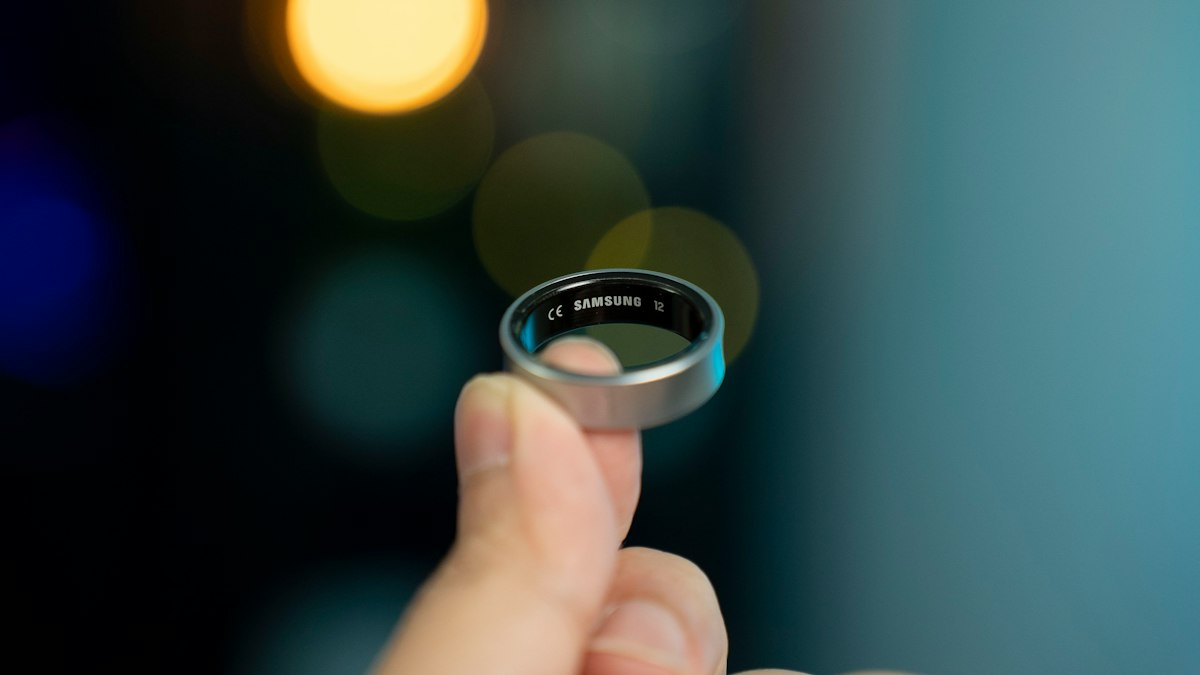
San Jose, California. Early October. Inside a windowless demo room at Samsung’s Device Solutions America campus, a Samsung Health product manager slid a titanium ring onto her index finger, pressed her thumb flat against its outer face, and waited three seconds. A waveform appeared on a paired phone: a single-lead electrocardiogram, the same basic trace a hospital cardiac monitor produces, generated by a ring smaller than a dime. That alone would not have been news. Apple has shipped ECG-capable watches since 2018. What made the room go quiet was the second screen, the one showing thirteen other values updating in real time: skin conductance, tissue fluid balance, muscle electrical activity, a derived vascular tone score, all pulled from a device that touches the wearer at exactly one point on the body.
Samsung is calling the finished product simply the Bio-Ring, a successor to the Galaxy Ring it launched in July 2024 at an Unpacked event in Paris. That distinction matters more than it sounds. The original Galaxy Ring carries no electrodes at all. Every number it produces, heart rate, skin temperature, sleep stage, comes from an optical photoplethysmography sensor and a thermistor, the same category of sensing found in pulse oximeters and infrared thermometers. It measures blood flow and heat. It does not measure electricity. The Bio-Ring does, and that is the actual story here: Samsung has moved real bioelectric instrumentation, the kind normally confined to a hospital bed or a clinic’s body composition scale, onto a piece of jewelry.
How Samsung Squeezed a Body’s Worth of Electricity Onto One Finger
Electrocardiography needs two points of contact on opposite sides of the heart’s electrical field, which is why every consumer ECG wearable to date, the Apple Watch, the Galaxy Watch, Withings’ ScanWatch, requires a second hand to close the circuit. A ring cannot do that with the same trick a watch uses, since a watch’s crown sits conveniently under the opposite thumb. Samsung’s engineers solved it the same way: a conductive plate on the ring’s outer face, touched by the wearer’s other thumb for a few seconds, completes the loop. It is not continuous, unobtrusive monitoring the way a chest patch would offer. It is a spot check, on demand, the same limitation every ring and watch ECG has always had.
The interesting engineering is not the ECG. It is the bioimpedance side, and it explains where most of those fourteen markers actually come from. Samsung has run a single-frequency bioelectrical impedance sensor in its watches since the Galaxy Watch4 in 2021, using it to estimate body fat percentage and skeletal muscle mass. That works by pushing a tiny alternating current through tissue and measuring the resistance. The Bio-Ring extends the same electrode pair across a spectrum of frequencies instead of one, a technique called bioimpedance spectroscopy. Low-frequency current mostly travels around cells, through extracellular fluid, because cell membranes act like poorly conductive walls at low frequency. High-frequency current passes straight through those membranes, into the intracellular space, the way it would through a capacitor. Sweep the frequency from roughly 1 kHz up past 500 kHz and record how resistance and reactance shift at each step, and you get a curve that separates fluid inside cells from fluid outside them, and a phase angle that clinicians already use as a rough proxy for cell membrane integrity. That single sweep, repeated through electrodes on a ring band small enough to sit under a knuckle, is what turns one body composition estimate into a dozen distinct readings.
The Fourteen, Listed
Samsung has not published a formal spec sheet yet, but the product manager walked the room through each value on the second screen. Combined with the single ECG lead, they add up to fourteen.
- Single-lead ECG rhythm: a thirty-second thumb-to-ring electrical trace of the heartbeat, the same basic waveform a hospital monitor shows.
- Resting heart rate: beats per minute measured during stillness, pulled from both the ECG spot check and continuous optical sensing.
- Heart rate variability: the millisecond-level spacing between beats, used as a general marker of recovery and nervous system balance.
- Respiration rate: breaths per minute, estimated from the tiny impedance changes that occur as the chest and finger vasculature shift with each breath.
- Electrodermal activity: skin conductance changes driven by sweat gland activity, a classic marker of stress and arousal.
- Body fat percentage: estimated from bioimpedance, the same calculation Samsung has run in its watches since 2021.
- Skeletal muscle mass: an estimate of lean muscle tissue derived from the same impedance pathway.
- Total body water: overall hydration level, calculated from how easily current moves through the body’s fluid.
- Extracellular to intracellular fluid ratio: the balance of fluid outside versus inside cells, separated using the low-frequency and high-frequency ends of the impedance sweep.
- Tissue hydration index: a localized hydration reading at the finger, useful as a short-term trend rather than a body-wide figure.
- Bioimpedance phase angle: a cellular health proxy tied to how well cell membranes hold their charge, used in clinical nutrition to flag declining tissue condition.
- Surface electromyography, muscle activity: small electrical signals from muscle fibers near the finger, used mainly to flag grip strain and tremor patterns.
- Vascular tone score: a derived index combining pulse wave timing and impedance shifts to estimate how constricted or relaxed blood vessels are.
- Autonomic stress index: a composite score built from heart rate variability and electrodermal activity, meant to summarize sympathetic nervous system load in one number.
Two things stand out about that list. First, only one entry, the ECG, is a direct electrical measurement of the heart itself. Everything else is either bioimpedance, run through the same finger electrodes at varying frequencies, or a downstream calculation built on top of it. Second, none of it is new science. Bioimpedance spectroscopy has been used in dialysis clinics and sports science labs for two decades. What is new is fitting the electrode pair, the signal generator, and the processing into a ring band, and doing it without a battery compartment big enough to see from across the room.
“We didn’t invent a new way to measure the body,” the product manager said when someone asked the obvious question. “We found a way to fit forty years of impedance research around a finger.”
The Honest Caveat
None of this makes the Bio-Ring a medical device in the way a hospital telemetry unit is one, and Samsung was careful not to claim otherwise in the room. The ECG remains a spot check, not continuous monitoring. It requires the wearer to stop, place a thumb on the plate, and hold still for several seconds, the same tradeoff every ring or watch ECG has made since the feature first appeared. Bioimpedance numbers, similarly, are estimates built on population models, not direct tissue biopsies, and they drift with hydration, food intake, and even room temperature. A vascular tone score or an autonomic stress index is a derived composite, one more layer removed from raw physiology, useful as a trend line over weeks rather than a diagnosis on any single day.
What the demo room actually showed was narrower and, in its way, more interesting than a medical breakthrough: proof that electrodes, not just optical sensors, can now live comfortably on a ring. That single fact reopens a category Samsung itself helped close off in July 2024, when it shipped the Galaxy Ring with no electrical sensing at all. The Bio-Ring is Samsung’s answer to its own earlier bet, and fourteen markers, however many of them are estimates layered on estimates, is a considerably larger answer than one screen away.