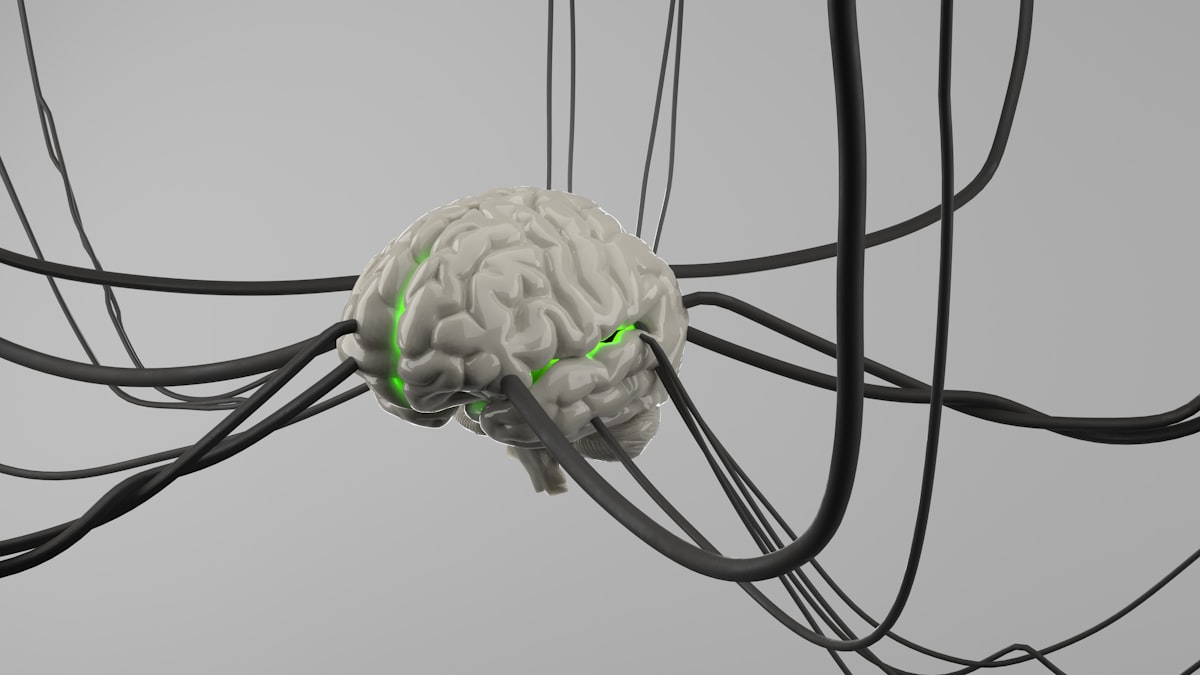
Photo via Unsplash
Deep brain stimulation has transformed the treatment of Parkinson’s disease, essential tremor, and dystonia—but the hardware has remained largely unchanged for decades. The real innovation is now happening in software: artificial intelligence systems that can personalize stimulation parameters, predict symptom fluctuations, and enable fully closed-loop control of neural circuits. This software revolution is turning a blunt instrument into something approaching a precision tool.
The Programming Problem That AI Is Solving
The challenge with conventional DBS programming is that the parameter space is enormous. Surgeons can adjust stimulation frequency, pulse width, amplitude, and the specific electrode contacts used—creating thousands of potential combinations for a single patient. Finding optimal settings typically requires multiple clinic visits spread over months, relying heavily on subjective patient reports and clinical observation of tremor, rigidity, and gait. A neurologist with decades of experience might spend four hours programming a new patient and still leave significant therapeutic benefit on the table.
AI-driven programming tools are beginning to automate this process systematically. Systems trained on data from thousands of patients can predict near-optimal stimulation parameters from electrode location, patient characteristics, and symptom profile—reducing initial programming time from hours to minutes and achieving outcomes comparable to expert manual programming. This matters enormously in practice: there are roughly 40,000 new DBS implants annually in the United States, but only a few hundred neurologists with deep DBS programming expertise. AI assistants can effectively scale that expertise to any clinic with an implant program.
More sophisticated systems go beyond initial programming to enable ongoing optimization. Machine learning algorithms trained on continuous neural recordings can identify patterns that predict when symptoms are about to worsen—the pathological beta-band oscillations that characterize Parkinson’s often increase minutes before a patient notices clinical deterioration. By detecting these early warning signatures, future systems may enable preemptive stimulation adjustments, maintaining therapeutic benefit through the full cycle of daily activity rather than just optimizing for the average state captured during a clinic visit.
Closed-Loop Control: When the Brain Talks Back
The most transformative development is the shift from open-loop to closed-loop DBS. Conventional systems are open-loop: they deliver fixed stimulation regardless of what the brain is doing. Medtronic’s Percept platform introduced the first commercially available sensing capability, allowing the same electrode that delivers stimulation to record local field potentials from surrounding tissue. This bidirectional communication—stimulate, record, respond—is the foundation of closed-loop control.
In Parkinson’s disease, the target biomarker is beta-band oscillations (13-35 Hz) in the subthalamic nucleus. These oscillations are pathologically amplified when dopamine is depleted, directly correlating with motor symptoms. When beta power rises above a patient-specific threshold, the closed-loop system increases stimulation; when it falls, stimulation decreases. Early clinical trials demonstrated that this adaptive approach achieves equivalent symptom control at roughly 40% lower total stimulation dose compared to conventional therapy—a significant advantage for battery life and, more importantly, for reducing stimulation-related side effects like speech difficulty and mood changes that often occur when stimulation is chronically over-delivered.
The clinical implications extend beyond efficiency. Parkinson’s symptoms fluctuate dramatically throughout the day, driven by medication timing, sleep, stress, and activity. A fixed stimulation setting optimized for the patient’s average state inevitably over-stimulates during low-symptom periods and under-stimulates during high-symptom periods. Closed-loop control tracks these fluctuations in real time, delivering the right amount of stimulation moment to moment. Patients report more consistent function across the full day—smoother transitions between medication on and off states, better performance during demanding cognitive and motor tasks, and fewer dyskinesias from stimulation overshoot.
The Road to Brain Pacemakers
The convergence of sensing, machine learning, and stimulation capabilities is pushing toward a new paradigm: DBS systems that function like pacemakers for the brain. Just as cardiac pacemakers monitor heart rhythm and intervene only when needed, next-generation neural interfaces will continuously track the brain’s electrical state and apply corrective stimulation with millisecond precision—without requiring any clinic visits for adjustment.
This vision requires solving several remaining technical challenges. Neural signals recorded from DBS electrodes are dominated by stimulation artifacts—the electrical signature of the stimulation pulse itself overwhelms nearby neural recordings. Separating genuine neural activity from these artifacts requires sophisticated signal processing that current commercial systems handle imperfectly. Second-generation sensing architectures that use separate stimulation and recording sites, combined with improved artifact rejection algorithms, are emerging from research labs and early-stage companies.
The longer arc of this technology points beyond Parkinson’s. Depression, OCD, and epilepsy are already approved or investigational DBS indications. The ability to close the loop on psychiatric conditions—reading the neural signatures of depressive episodes or pre-seizure states and intervening before symptoms escalate—could fundamentally change how these conditions are managed. The software revolution in DBS is not just about treating movement disorders better. It is about proving that the brain’s electrical activity can be read, understood, and therapeutically guided in real time. That capability, once established, will extend far beyond the conditions for which DBS was originally developed.
The Algorithm Learns; the Patient Benefits
One underappreciated aspect of the AI revolution in DBS programming is what happens to the algorithms as more patients are programmed with them. Each programming session generates data—electrode positions, patient characteristics, initial symptom burden, parameter choices, and outcomes—that can be used to refine the predictive models underlying the programming assistance. As the dataset grows, the algorithms become more accurate, and the benefit extends to future patients who may have characteristics underrepresented in the initial training data. This learning dynamic is fundamentally different from conventional medical devices, which do not improve with use.
An AI-assisted DBS programming system in a hospital that has programmed ten thousand patients should be meaningfully better than the same system in a hospital that has programmed one hundred—and both should outperform a neurologist working without algorithmic assistance, at least for the initial programming tasks where pattern recognition advantages are largest. The implication is that concentrating DBS volume in centers of excellence, already the standard of care, becomes even more important in an era of AI-assisted programming: the algorithm’s advantage compounds with data, and data comes from volume.
The best DBS programming system of 2030 will be trained on data generated by devices implanted today—a compounding return on every patient’s participation in the connected care ecosystem.
Sources and Further Reading
- Little, S. et al. (2016). Bilateral adaptive deep brain stimulation is effective in Parkinson’s disease. Journal of Neurology, Neurosurgery & Psychiatry.
- Arlotti, M. et al. (2018). 8-hours adaptive deep brain stimulation in patients with Parkinson disease. Neurology, 90(11).
- Tinkhauser, G. et al. (2017). The modulatory effect of adaptive deep brain stimulation on beta bursts in Parkinson’s disease. Brain, 140(4).