Photo via Unsplash
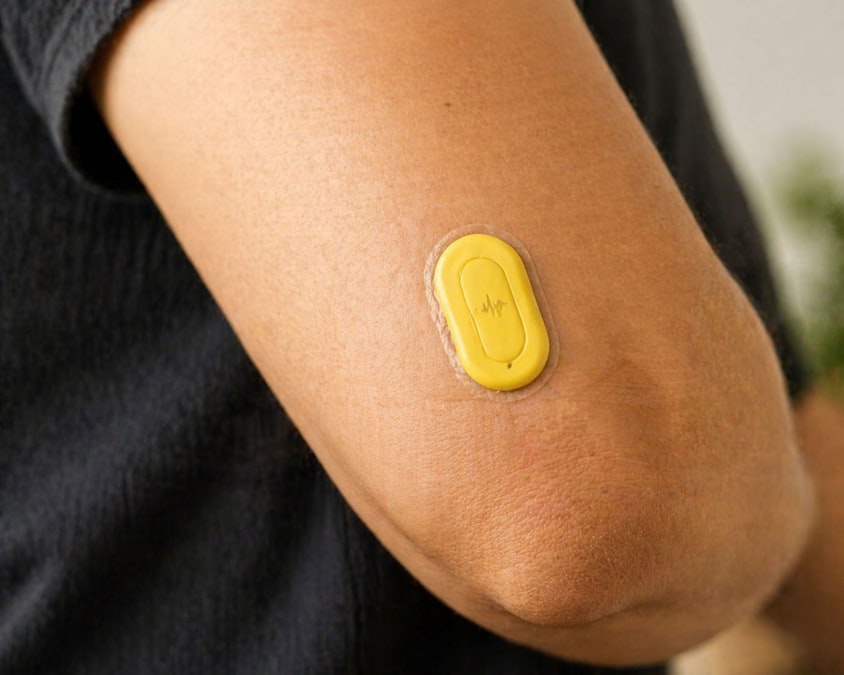
Researchers have developed a new class of electronic tattoo—a thin, flexible biosensor adhered directly to skin—capable of simultaneously monitoring cardiac electrical activity and muscle function with clinical-grade accuracy. The device represents a significant step toward continuous, comfortable health monitoring outside traditional clinical settings, and points toward a future where hospital-quality physiological data can be gathered from anyone, anywhere, at any time.
The Problem With Current Wearable Monitoring
Conventional cardiac and EMG monitoring requires bulky equipment, gel electrodes that dry out over hours, and adhesive patches that irritate skin after a day or two of continuous wear. Clinical Holter monitors—the standard for extended cardiac monitoring—consist of a recorder the size of a deck of cards connected by wires to five or more electrodes distributed across the chest. Patients wear these for 24 to 48 hours, during which they are instructed to avoid showering, limit physical activity, and maintain a careful diary of symptoms. The resulting data is invaluable, but the monitoring period captures only a narrow window of a patient’s life, and the system’s intrusiveness inevitably changes the behaviors being monitored.
The electronic tattoo approaches this problem from first principles. The device is a thin-film electronic system—approximately 300 microns thick, comparable to a sheet of paper—fabricated from a conductive polymer composite deposited on a biocompatible substrate that conforms to skin contours. Unlike conventional gel electrodes that rely on a conductive paste to maintain electrical contact, the tattoo’s dry electrodes interface directly with the stratum corneum, the outermost layer of skin. The polymer composite is formulated to maintain reliable electrical contact through sweat, minor skin deformation from movement, and the gradual shedding of skin cells that occurs continuously over days of wear.
Signal quality achieved by the tattoo electrodes matches clinical-grade gel electrodes for most diagnostic purposes—a finding validated through parallel recording sessions comparing tattoo ECG to standard 12-lead electrocardiography and tattoo EMG to needle electromyography in controlled conditions. The concordance is particularly strong for rhythm monitoring applications: P wave morphology, QRS complex duration, and T wave characteristics are all preserved with sufficient fidelity for arrhythmia detection and classification.
Simultaneous Cardiac and Muscle Monitoring
What distinguishes this device from earlier electronic skin work is its integration of multiple physiological channels in a single conformal platform. Previous flexible electronics demonstrations typically focused on a single measurement modality—either cardiac electrical activity or muscle activity, not both simultaneously. Combining them requires careful attention to signal separation, since the cardiac action potential and skeletal muscle motor unit action potentials overlap in both frequency content and amplitude range.
The tattoo’s electrode array is designed to exploit the spatial separation between cardiac and muscle sources. Electrodes positioned over the chest wall predominantly record cardiac signals; electrodes over muscle bellies capture EMG. An onboard signal processing chip applies spatial filtering algorithms that weight electrode contributions according to source geometry, effectively separating cardiac from muscular contributions to the recorded signal even when their frequency spectra overlap.
This dual-channel capability opens diagnostic possibilities that neither modality alone could provide. Cardiac rehabilitation after a heart attack requires both monitoring for arrhythmias and tracking the muscle recovery that determines functional prognosis. Athletes recovering from injuries need both cardiac safety monitoring during exertion and quantitative assessment of muscle recruitment patterns that indicate whether compensatory movement strategies are developing. The tattoo’s wireless data transmission system allows continuous streaming to a smartphone app, enabling real-time analysis and the accumulation of longitudinal data across weeks or months—timescales over which subtle trends in cardiac and muscle function become diagnostically meaningful.
The Path to Clinical Adoption
Electronic tattoos face a different set of adoption challenges than traditional medical devices. Patients who might readily accept a wristband or patch may have different responses to something described as a tattoo, even when the term refers to a temporary, non-ink device that peels off after a week. Clinical validation will need to address not just technical performance—signal quality, wear duration, artifact rejection—but also patient acceptability across diverse populations with different levels of comfort with body-worn technology.
Regulatory pathway decisions will significantly shape how quickly these devices reach patients. A device that monitors for arrhythmia detection is a Class II or Class III medical device requiring premarket clearance or approval; a wellness device that tracks general cardiac trends occupies a different regulatory space with a faster path to market but more limited clinical applications. Most groups developing electronic tattoo technology are pursuing the wellness pathway initially, building a foundation of real-world performance data while pursuing clinical evidence for specific diagnostic applications.
The longer-term applications extend beyond cardiology and rehabilitation. Continuous EMG monitoring could detect the earliest signs of neuromuscular disease progression in patients with ALS or muscular dystrophy, potentially enabling clinical trial endpoints that are more sensitive than current functional assessments. Paired with accelerometry and skin temperature sensors in a multimodal tattoo array, the technology could approach a comprehensive physiological portrait—the kind of continuous, comprehensive monitoring that is currently possible only in an ICU, but available to anyone going about their ordinary life.
The Continuous Care Vision
The electronic tattoo points toward a model of healthcare that is fundamentally different from the episodic, clinic-based model that has prevailed since the beginning of organized medicine. In the episodic model, a patient is sick, visits a clinician, is assessed during the visit, and receives treatment based on that assessment. The continuous monitoring model that wearable biosensors enable replaces the snapshot with a movie: continuous physiological data that captures not just average states but fluctuations, trends, and rare events that a clinic visit has essentially no chance of documenting. Cardiac arrhythmias, for example, are often intermittent—they may occur once per week, making the probability of capturing one during a standard 30-second ECG essentially zero. A continuously monitoring electronic tattoo captures every arrhythmia that occurs during its wear period. For conditions where diagnosis depends on documenting what happens during rare events, continuous monitoring is not just more convenient than episodic monitoring—it is categorically more informative.
The electronic tattoo points toward a model of healthcare that is fundamentally different from the episodic, clinic-based approach that has prevailed throughout the history of organized medicine. In the episodic model, a patient is assessed during a visit and treated based on a snapshot of their condition at that moment. The continuous monitoring model that wearable biosensors enable replaces the snapshot with a longitudinal record—capturing not just average states but fluctuations, trends, and rare events that a clinical encounter has essentially no chance of documenting. Cardiac arrhythmias, for instance, may occur once per week; the probability of capturing one during a standard 30-second ECG is essentially zero. A continuously monitoring electronic tattoo captures every arrhythmia during its wear period. For conditions that depend on rare-event documentation, continuous monitoring is not merely more convenient—it is categorically more informative.
Sources and Further Reading
- Xu, S. et al. (2014). Soft microfluidic assemblies of sensors, circuits, and radios for the skin. Science, 344(6179).
- Yang, Y. et al. (2021). A laser-engraved wearable sensor for sensitive detection of uric acid and creatinine in sweat. Nature Biotechnology.
- Gao, W. et al. (2016). Fully integrated wearable sensor arrays for multiplexed in situ perspiration analysis. Nature, 529.